Relative to an origin O, the position vectors of the points A, B, C and D are given by
\(\overrightarrow{OA} = \begin{pmatrix} 1 \\ 3 \\ -1 \end{pmatrix}, \overrightarrow{OB} = \begin{pmatrix} 3 \\ -1 \\ 3 \end{pmatrix}, \overrightarrow{OC} = \begin{pmatrix} 4 \\ 2 \\ p \end{pmatrix} \text{ and } \overrightarrow{OD} = \begin{pmatrix} -1 \\ 0 \\ q \end{pmatrix}\),
where \(p\) and \(q\) are constants. Find
(i) the unit vector in the direction of \(\overrightarrow{AB}\),
(ii) the value of \(p\) for which angle \(AOC = 90^\circ\),
(iii) the values of \(q\) for which the length of \(\overrightarrow{AD}\) is 7 units.
Solution
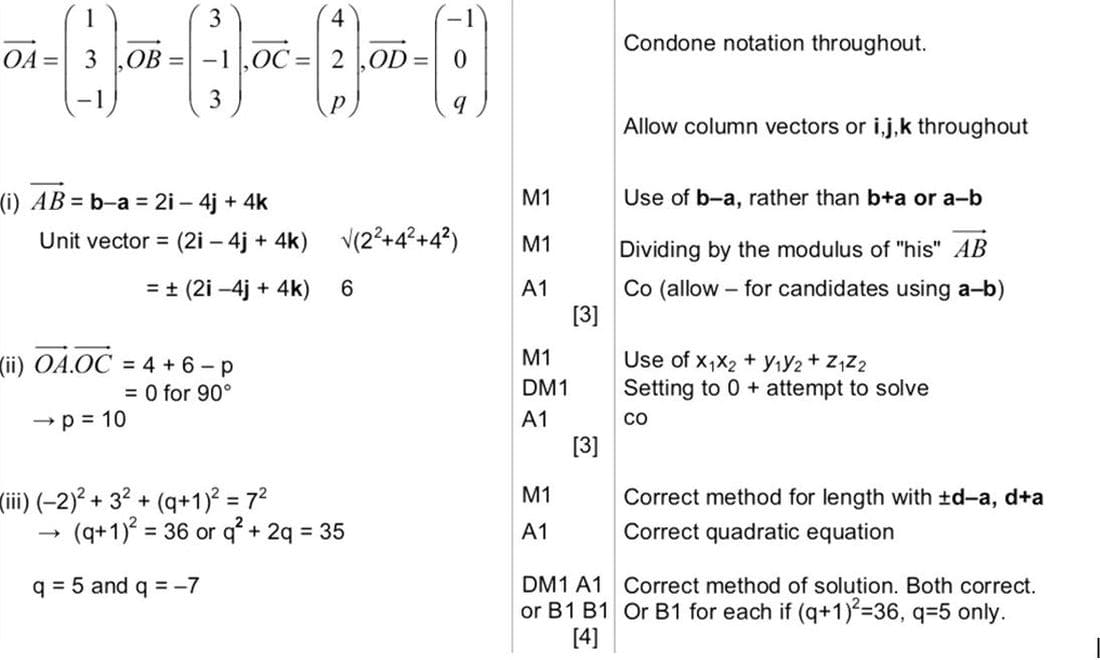
(i) The vector \(\overrightarrow{AB}\) is given by \(\overrightarrow{OB} - \overrightarrow{OA} = \begin{pmatrix} 3 \\ -1 \\ 3 \end{pmatrix} - \begin{pmatrix} 1 \\ 3 \\ -1 \end{pmatrix} = \begin{pmatrix} 2 \\ -4 \\ 4 \end{pmatrix}\).
The magnitude of \(\overrightarrow{AB}\) is \(\sqrt{2^2 + (-4)^2 + 4^2} = 6\).
Thus, the unit vector in the direction of \(\overrightarrow{AB}\) is \(\pm \frac{1}{6} \begin{pmatrix} 2 \\ -4 \\ 4 \end{pmatrix}\).
(ii) For \(\angle AOC = 90^\circ\), the dot product \(\overrightarrow{OA} \cdot \overrightarrow{OC} = 0\).
\(\overrightarrow{OA} \cdot \overrightarrow{OC} = \begin{pmatrix} 1 \\ 3 \\ -1 \end{pmatrix} \cdot \begin{pmatrix} 4 \\ 2 \\ p \end{pmatrix} = 4 + 6 - p = 0\).
Solving for \(p\), we get \(p = 10\).
(iii) The length of \(\overrightarrow{AD}\) is given by \(\sqrt{(-2)^2 + 3^2 + (q+1)^2} = 7\).
\((-2)^2 + 3^2 + (q+1)^2 = 49\).
\(4 + 9 + (q+1)^2 = 49\).
\((q+1)^2 = 36\).
Solving \((q+1)^2 = 36\) gives \(q+1 = 6\) or \(q+1 = -6\).
Thus, \(q = 5\) or \(q = -7\).
Log in to record attempts.