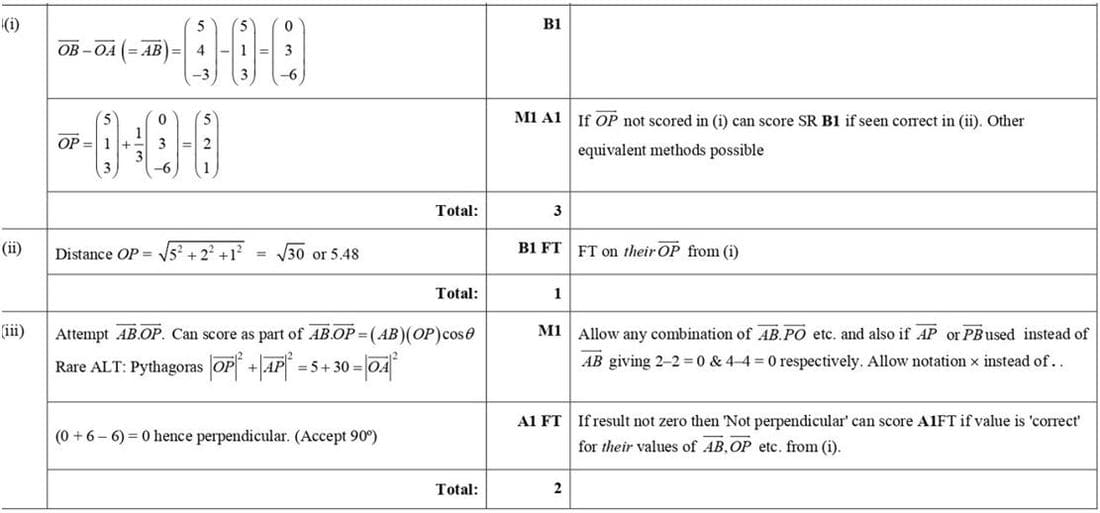
(i) First, find \(\overrightarrow{AB}\) by subtracting \(\overrightarrow{OA}\) from \(\overrightarrow{OB}\):
\(\overrightarrow{AB} = \overrightarrow{OB} - \overrightarrow{OA} = \begin{pmatrix} 5 \\ 4 \\ -3 \end{pmatrix} - \begin{pmatrix} 5 \\ 1 \\ 3 \end{pmatrix} = \begin{pmatrix} 0 \\ 3 \\ -6 \end{pmatrix}\).
Then, find \(\overrightarrow{AP}\):
\(\overrightarrow{AP} = \frac{1}{3} \overrightarrow{AB} = \frac{1}{3} \begin{pmatrix} 0 \\ 3 \\ -6 \end{pmatrix} = \begin{pmatrix} 0 \\ 1 \\ -2 \end{pmatrix}\).
Now, find \(\overrightarrow{OP}\) by adding \(\overrightarrow{OA}\) and \(\overrightarrow{AP}\):
\(\overrightarrow{OP} = \overrightarrow{OA} + \overrightarrow{AP} = \begin{pmatrix} 5 \\ 1 \\ 3 \end{pmatrix} + \begin{pmatrix} 0 \\ 1 \\ -2 \end{pmatrix} = \begin{pmatrix} 5 \\ 2 \\ 1 \end{pmatrix}\).
(ii) The distance \(OP\) is the magnitude of \(\overrightarrow{OP}\):
\(OP = \sqrt{5^2 + 2^2 + 1^2} = \sqrt{30} \approx 5.48\).
(iii) To check if \(OP\) is perpendicular to \(AB\), calculate the dot product \(\overrightarrow{AB} \cdot \overrightarrow{OP}\):
\(\overrightarrow{AB} \cdot \overrightarrow{OP} = \begin{pmatrix} 0 \\ 3 \\ -6 \end{pmatrix} \cdot \begin{pmatrix} 5 \\ 2 \\ 1 \end{pmatrix} = 0 \times 5 + 3 \times 2 + (-6) \times 1 = 0 + 6 - 6 = 0\).
Since the dot product is zero, \(OP\) is perpendicular to \(AB\).