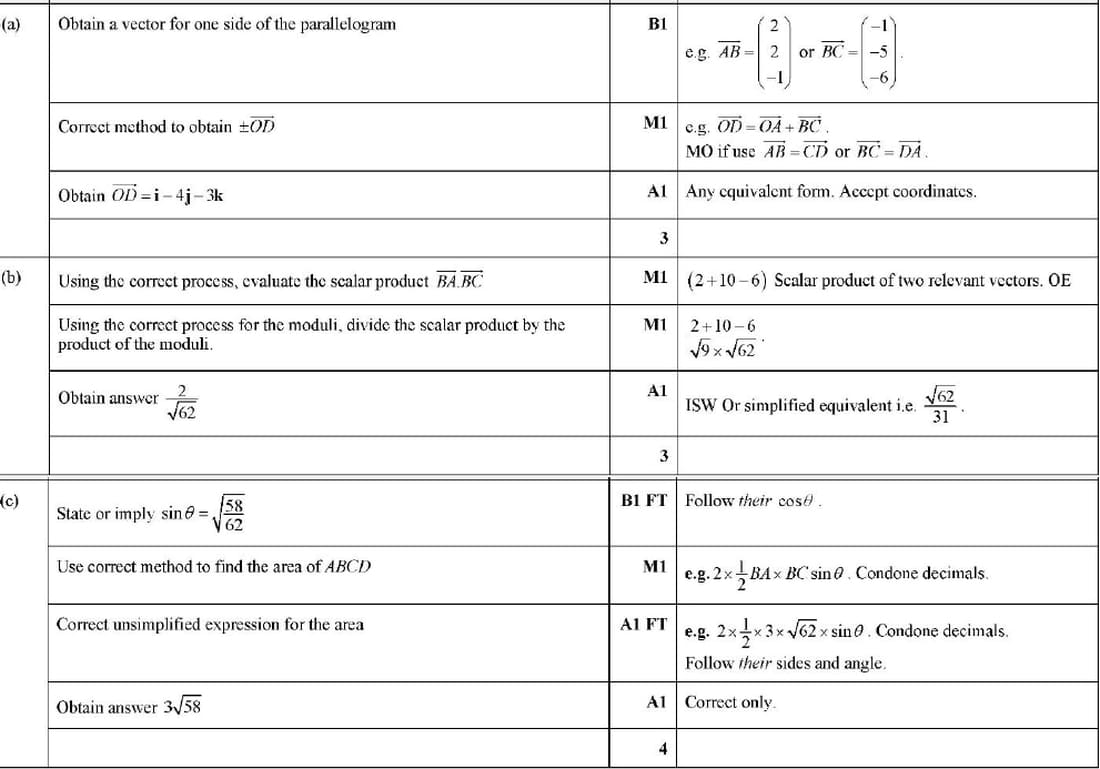
(a) To find \(\overrightarrow{OD}\), use the property of a parallelogram: \(\overrightarrow{AB} = \overrightarrow{CD}\). Calculate \(\overrightarrow{AB} = \overrightarrow{OB} - \overrightarrow{OA} = \begin{pmatrix} 4 \\ 3 \\ 2 \end{pmatrix} - \begin{pmatrix} 2 \\ 1 \\ 3 \end{pmatrix} = \begin{pmatrix} 2 \\ 2 \\ -1 \end{pmatrix}\).
Then, \(\overrightarrow{OD} = \overrightarrow{OC} + \overrightarrow{AB} = \begin{pmatrix} 3 \\ -2 \\ -4 \end{pmatrix} + \begin{pmatrix} 2 \\ 2 \\ -1 \end{pmatrix} = \begin{pmatrix} 1 \\ -4 \\ -3 \end{pmatrix}\).
(b) To find \(\cos \theta\), use the dot product formula: \(\overrightarrow{BA} \cdot \overrightarrow{BC} = \|\overrightarrow{BA}\| \|\overrightarrow{BC}\| \cos \theta\).
Calculate \(\overrightarrow{BA} = \overrightarrow{OA} - \overrightarrow{OB} = \begin{pmatrix} 2 \\ 1 \\ 3 \end{pmatrix} - \begin{pmatrix} 4 \\ 3 \\ 2 \end{pmatrix} = \begin{pmatrix} -2 \\ -2 \\ 1 \end{pmatrix}\).
Calculate \(\overrightarrow{BC} = \overrightarrow{OC} - \overrightarrow{OB} = \begin{pmatrix} 3 \\ -2 \\ -4 \end{pmatrix} - \begin{pmatrix} 4 \\ 3 \\ 2 \end{pmatrix} = \begin{pmatrix} -1 \\ -5 \\ -6 \end{pmatrix}\).
Dot product: \(\overrightarrow{BA} \cdot \overrightarrow{BC} = (-2)(-1) + (-2)(-5) + (1)(-6) = 2 + 10 - 6 = 6\).
Magnitudes: \(\|\overrightarrow{BA}\| = \sqrt{(-2)^2 + (-2)^2 + 1^2} = \sqrt{9} = 3\), \(\|\overrightarrow{BC}\| = \sqrt{(-1)^2 + (-5)^2 + (-6)^2} = \sqrt{62}\).
\(\cos \theta = \frac{6}{3 \times \sqrt{62}} = \frac{2}{\sqrt{62}}\).
(c) The area of parallelogram \(ABCD\) is given by \(\text{Area} = \|\overrightarrow{BA}\| \|\overrightarrow{BC}\| \sin \theta\).
\(\sin \theta = \sqrt{1 - \cos^2 \theta} = \sqrt{1 - \left(\frac{2}{\sqrt{62}}\right)^2} = \sqrt{\frac{58}{62}}\).
\(\text{Area} = 3 \times \sqrt{62} \times \sqrt{\frac{58}{62}} = 3 \sqrt{58}\).