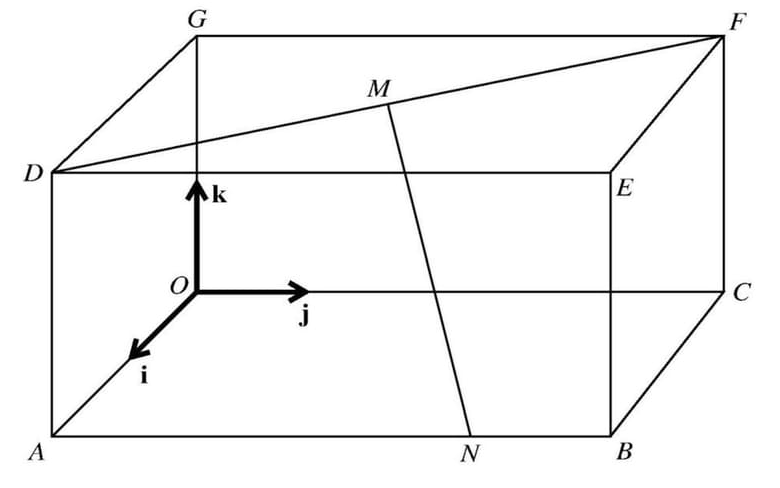
(a) To find \(\overrightarrow{OM}\), note that M is the midpoint of DF. Since D is at \((0, 4, 2)\) and F is at \((2, 4, 4)\), M is at \(\left( \frac{0+2}{2}, \frac{4+4}{2}, \frac{2+4}{2} \right) = (1, 4, 3)\). Thus, \(\overrightarrow{OM} = \mathbf{i} + 2\mathbf{j} + 2\mathbf{k}\).
For \(\overrightarrow{MN}\), N divides AB in the ratio 3:1. A is at \((2, 0, 0)\) and B is at \((2, 4, 0)\), so N is at \(\left( 2, \frac{3 \times 0 + 1 \times 4}{4}, 0 \right) = (2, 3, 0)\). Thus, \(\overrightarrow{MN} = (2 - 1)\mathbf{i} + (3 - 4)\mathbf{j} + (0 - 2)\mathbf{k} = \mathbf{i} + \mathbf{j} - 2\mathbf{k}\).
(b) The vector equation of the line through M and N is given by \(\mathbf{r} = \overrightarrow{OM} + \lambda \overrightarrow{MN}\). Substituting the vectors, we get \(\mathbf{r} = (\mathbf{i} + 2\mathbf{j} + 2\mathbf{k}) + \lambda (\mathbf{i} + \mathbf{j} - 2\mathbf{k}) = 2\mathbf{i} + 3\mathbf{j} + \lambda (\mathbf{i} + \mathbf{j} - 2\mathbf{k})\).
(c) To find the perpendicular distance from O to the line through M and N, consider a point P on the line: \(\overrightarrow{OP} = 2\mathbf{i} + 3\mathbf{j} + \lambda (\mathbf{i} + \mathbf{j} - 2\mathbf{k})\). The direction vector of the line is \(\mathbf{i} + \mathbf{j} - 2\mathbf{k}\). The perpendicular distance is given by the magnitude of the projection of \(\overrightarrow{OP}\) onto the normal vector to the line. Solving for \(\lambda\) when the dot product of \(\overrightarrow{OP}\) and the direction vector is zero gives \(\lambda = -\frac{5}{6}\). Substituting back, the perpendicular distance is \(\sqrt{\left( \frac{7}{6} \right)^2 + \left( \frac{13}{6} \right)^2 + \left( \frac{5}{3} \right)^2} = \sqrt{\frac{53}{6}}\).