June 2022 p32 q9
2176
The lines l and m have vector equations
\(\mathbf{r} = -\mathbf{i} + 3\mathbf{j} + 4\mathbf{k} + \lambda(2\mathbf{i} - \mathbf{j} - \mathbf{k})\)
and
\(\mathbf{r} = 5\mathbf{i} + 4\mathbf{j} + 3\mathbf{k} + \mu(a\mathbf{i} + b\mathbf{j} + \mathbf{k})\)
respectively, where a and b are constants.
(a) Given that l and m intersect, show that \(2b - a = 4\).
(b) Given also that l and m are perpendicular, find the values of a and b.
(c) When a and b have these values, find the position vector of the point of intersection of l and m.
Solution
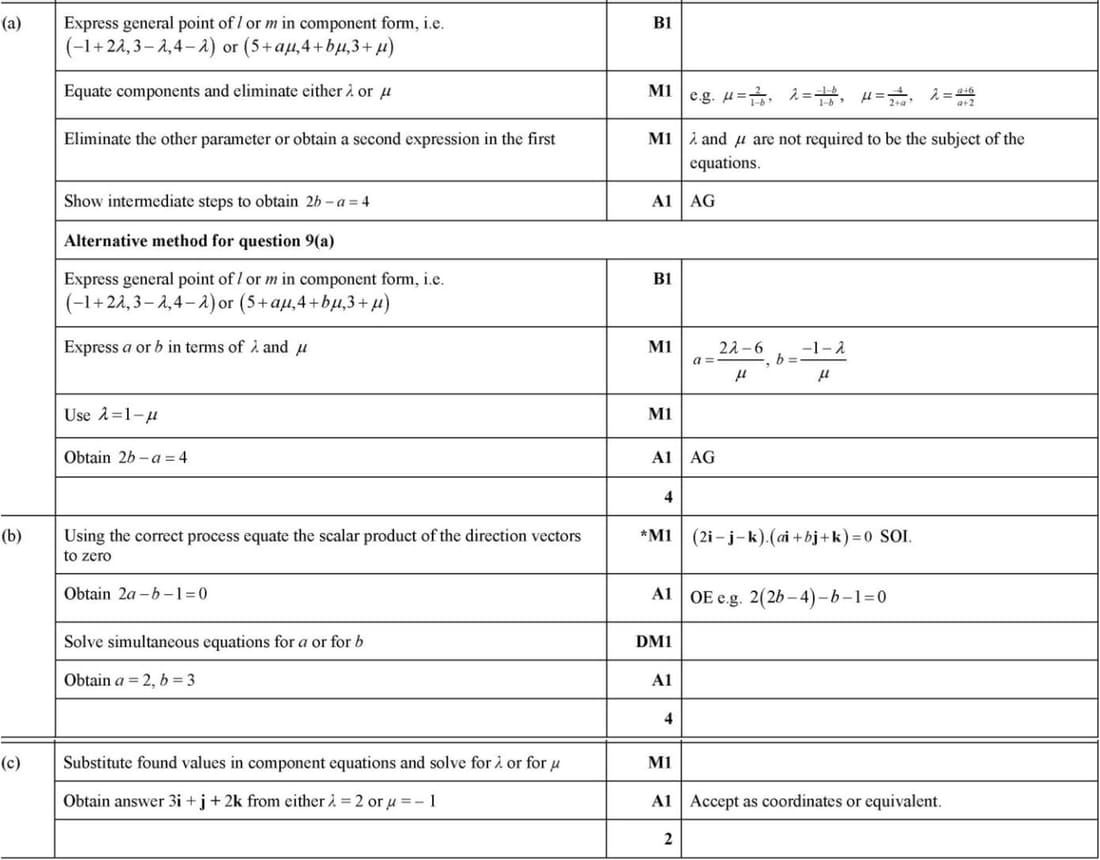
(a) Express the general point of l or m in component form:
\((-1 + 2\lambda, 3 - \lambda, 4 - \lambda)\)
\((5 + a\mu, 4 + b\mu, 3 + \mu)\)
Equate components and eliminate either \(\lambda\) or \(\mu\):
\(\mu = \frac{2\lambda - 6}{a}\)
\(\mu = \frac{-1 - \lambda}{b}\)
Use \(\lambda = 1 - \mu\) to obtain \(2b - a = 4\).
(b) For perpendicular lines, the scalar product of direction vectors is zero:
\((2\mathbf{i} - \mathbf{j} - \mathbf{k}) \cdot (a\mathbf{i} + b\mathbf{j} + \mathbf{k}) = 0\)
\(2a - b - 1 = 0\)
Solve simultaneous equations:
\(2a - b = 1\)
\(2b - a = 4\)
Obtain \(a = 2, b = 3\).
(c) Substitute \(a = 2\) and \(b = 3\) into component equations and solve for \(\lambda\) or \(\mu\):
Obtain position vector \(3\mathbf{i} + \mathbf{j} + 2\mathbf{k}\).
Log in to record attempts.