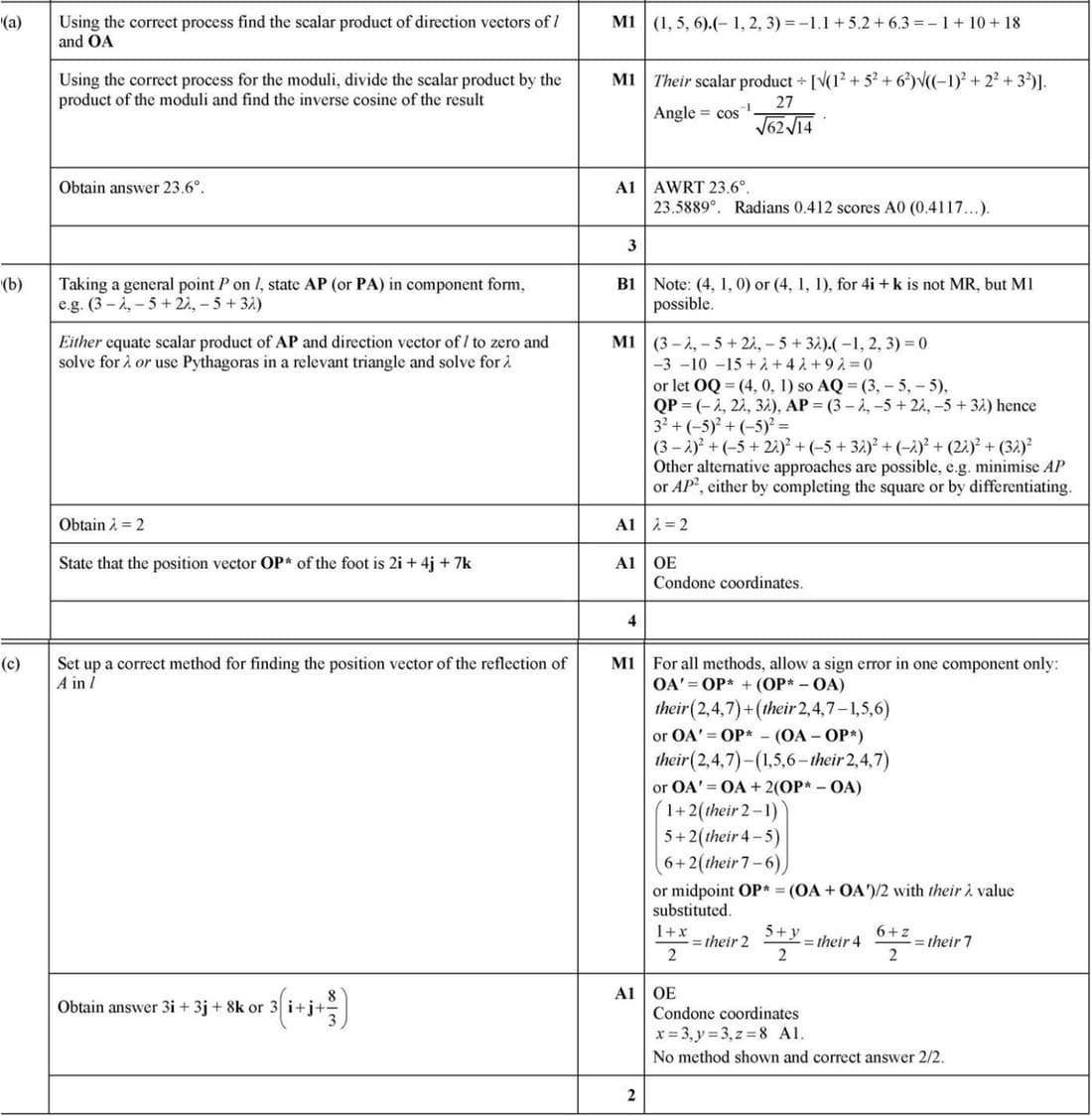
(a) The direction vector of \(OA\) is \(\langle 1, 5, 6 \rangle\) and the direction vector of \(l\) is \(\langle -1, 2, 3 \rangle\). The scalar product is \(1(-1) + 5(2) + 6(3) = -1 + 10 + 18 = 27\).
The moduli are \(\sqrt{1^2 + 5^2 + 6^2} = \sqrt{62}\) and \(\sqrt{(-1)^2 + 2^2 + 3^2} = \sqrt{14}\).
The cosine of the angle is \(\cos \theta = \frac{27}{\sqrt{62} \cdot \sqrt{14}}\).
Thus, \(\theta = \cos^{-1} \left( \frac{27}{\sqrt{62} \cdot \sqrt{14}} \right) \approx 23.6^{\circ}\).
(b) Let \(P\) be the foot of the perpendicular from \(A\) to \(l\). The position vector of \(P\) is \(\mathbf{OP} = 4\mathbf{i} + \mathbf{k} + \lambda (-\mathbf{i} + 2\mathbf{j} + 3\mathbf{k})\).
Set \(\mathbf{AP} \cdot \langle -1, 2, 3 \rangle = 0\) to find \(\lambda\). \(\mathbf{AP} = \langle 3 - \lambda, -5 + 2\lambda, -5 + 3\lambda \rangle\).
Solving \((3 - \lambda)(-1) + (-5 + 2\lambda)(2) + (-5 + 3\lambda)(3) = 0\) gives \(\lambda = 2\).
Thus, \(\mathbf{OP} = 2\mathbf{i} + 4\mathbf{j} + 7\mathbf{k}\).
(c) The reflection of \(A\) in \(l\) is \(\mathbf{A'} = \mathbf{OP} + (\mathbf{OP} - \mathbf{OA})\).
\(\mathbf{A'} = 2\mathbf{i} + 4\mathbf{j} + 7\mathbf{k} + (2\mathbf{i} + 4\mathbf{j} + 7\mathbf{k} - (\mathbf{i} + 5\mathbf{j} + 6\mathbf{k}))\).
\(\mathbf{A'} = 3\mathbf{i} + 3\mathbf{j} + 8\mathbf{k}\).