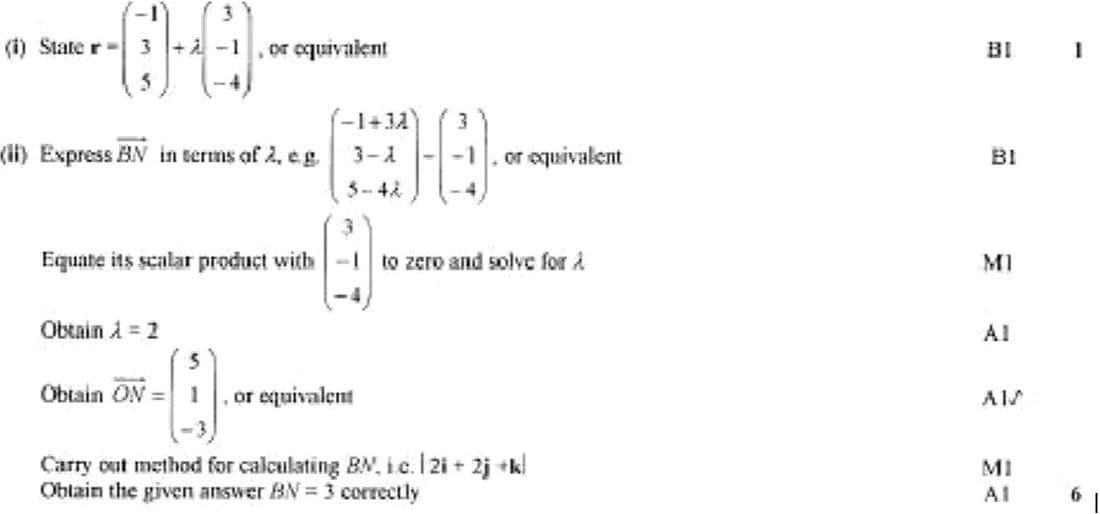
(i) The vector equation of the line l passing through A and parallel to OB is given by:
\(\mathbf{r} = \begin{pmatrix} -1 \\ 3 \\ 5 \end{pmatrix} + \lambda \begin{pmatrix} 3 \\ -1 \\ -4 \end{pmatrix}\)
where \(\lambda\) is a scalar.
(ii) To find the position vector of N, express \(\overrightarrow{BN}\) in terms of \(\lambda\):
\(\overrightarrow{BN} = \begin{pmatrix} -1 + 3\lambda \\ 3 - \lambda \\ 5 - 4\lambda \end{pmatrix} - \begin{pmatrix} 3 \\ -1 \\ -4 \end{pmatrix}\)
Equate its scalar product with \(\begin{pmatrix} 3 \\ -1 \\ -4 \end{pmatrix}\) to zero and solve for \(\lambda\):
\((3)(-1 + 3\lambda) + (-1)(3 - \lambda) + (-4)(5 - 4\lambda) = 0\)
Simplifying gives \(\lambda = 2\).
Substitute \(\lambda = 2\) back to find \(\overrightarrow{ON}\):
\(\overrightarrow{ON} = \begin{pmatrix} -1 + 6 \\ 3 - 2 \\ 5 - 8 \end{pmatrix} = \begin{pmatrix} 5 \\ 1 \\ -3 \end{pmatrix}\)
To show \(BN = 3\), calculate the magnitude of \(\overrightarrow{BN}\):
\(\overrightarrow{BN} = \begin{pmatrix} 5 - 3 \\ 1 + 1 \\ -3 + 4 \end{pmatrix} = \begin{pmatrix} 2 \\ 2 \\ 1 \end{pmatrix}\)
\(BN = \sqrt{2^2 + 2^2 + 1^2} = \sqrt{4 + 4 + 1} = \sqrt{9} = 3\)