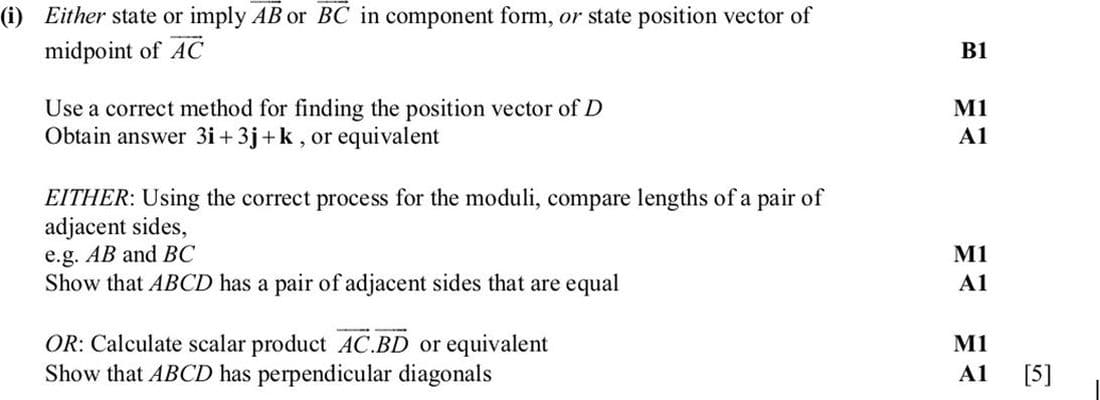
To find the position vector of D, we use the property of a parallelogram that opposite sides are equal and parallel. Therefore, \(\overrightarrow{AB} = \overrightarrow{CD}\).
First, calculate \(\overrightarrow{AB}\):
\(\overrightarrow{AB} = \overrightarrow{OB} - \overrightarrow{OA} = (0\mathbf{i} + 4\mathbf{j} + \mathbf{k}) - (\mathbf{i} + 2\mathbf{j} + 3\mathbf{k}) = -\mathbf{i} + 2\mathbf{j} - 2\mathbf{k}\).
Since \(\overrightarrow{CD} = \overrightarrow{AB}\), we have:
\(\overrightarrow{CD} = -\mathbf{i} + 2\mathbf{j} - 2\mathbf{k}\).
Now, find \(\overrightarrow{OD}\):
\(\overrightarrow{OD} = \overrightarrow{OC} + \overrightarrow{CD} = (2\mathbf{i} + 5\mathbf{j} - \mathbf{k}) + (-\mathbf{i} + 2\mathbf{j} - 2\mathbf{k}) = 3\mathbf{i} + 3\mathbf{j} + \mathbf{k}\).
To verify that ABCD is a rhombus, we need to show that all sides are equal in length. Calculate the magnitudes of \(\overrightarrow{AB}\) and \(\overrightarrow{BC}\):
\(|\overrightarrow{AB}| = \sqrt{(-1)^2 + 2^2 + (-2)^2} = \sqrt{9} = 3\).
\(\overrightarrow{BC} = \overrightarrow{OC} - \overrightarrow{OB} = (2\mathbf{i} + 5\mathbf{j} - \mathbf{k}) - (0\mathbf{i} + 4\mathbf{j} + \mathbf{k}) = 2\mathbf{i} + \mathbf{j} - 2\mathbf{k}\).
\(|\overrightarrow{BC}| = \sqrt{2^2 + 1^2 + (-2)^2} = \sqrt{9} = 3\).
Since \(|\overrightarrow{AB}| = |\overrightarrow{BC}|\), ABCD has a pair of adjacent sides that are equal, confirming it is a rhombus.