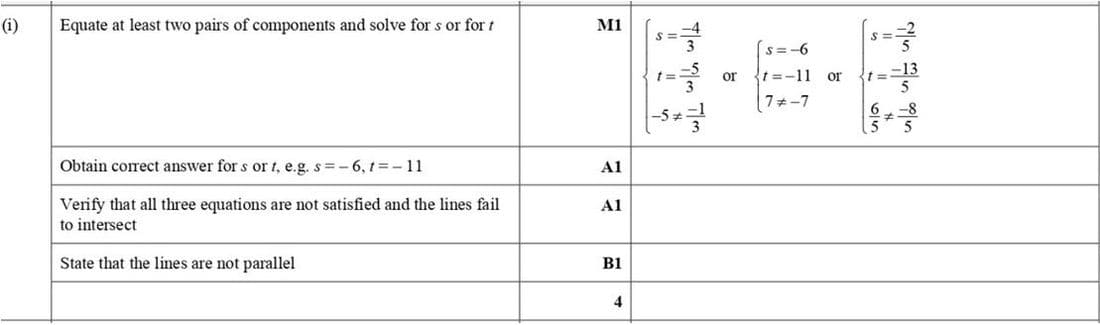
To determine if the lines are skew, we need to check if they are neither parallel nor intersecting.
First, equate the components of the lines:
For the i component: \(2 + 2s = 1 + t\)
For the j component: \(-1 + 3s = 3 + 2t\)
For the k component: \(1 - s = 4 + t\)
Solving these equations:
From \(2 + 2s = 1 + t\), we get \(t = 2s - 1\).
From \(-1 + 3s = 3 + 2t\), substitute \(t = 2s - 1\):
\(-1 + 3s = 3 + 2(2s - 1)\)
\(-1 + 3s = 3 + 4s - 2\)
\(-1 + 3s = 1 + 4s\)
\(-2 = s\)
Substitute \(s = -2\) into \(t = 2s - 1\):
\(t = 2(-2) - 1 = -4 - 1 = -5\)
Check the k component: \(1 - s = 4 + t\)
\(1 - (-2) = 4 + (-5)\)
\(3 \neq -1\)
The equations do not satisfy all components simultaneously, so the lines do not intersect.
Since the direction vectors \((2, 3, -1)\) and \((1, 2, 1)\) are not scalar multiples, the lines are not parallel.
Therefore, the lines are skew.