Browsing as Guest. Progress, bookmarks and attempts are disabled.
Log in to track your work.
9709 P32 - Mar 2020 - Q8 - 9 marks
2139
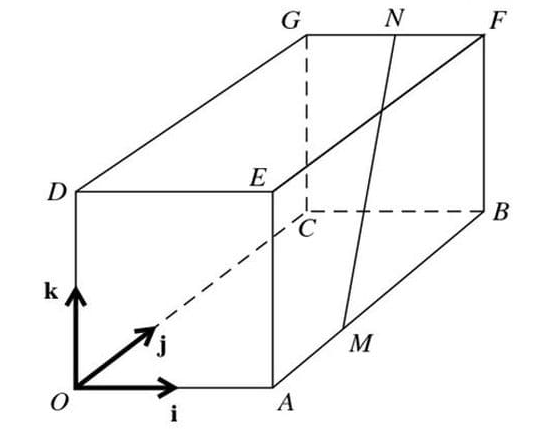
In the diagram, OABCDEFG is a cuboid in which OA = 2 units, OC = 3 units and OD = 2 units. Unit vectors i, j and k are parallel to OA, OC and OD respectively. The point M on AB is such that MB = 2AM. The midpoint of FG is N.
(a) Express the vectors \(\overrightarrow{OM}\) and \(\overrightarrow{MN}\) in terms of i, j and k.
(b) Find a vector equation for the line through M and N.
(c) Find the position vector of P, the foot of the perpendicular from D to the line through M and N.
Solution
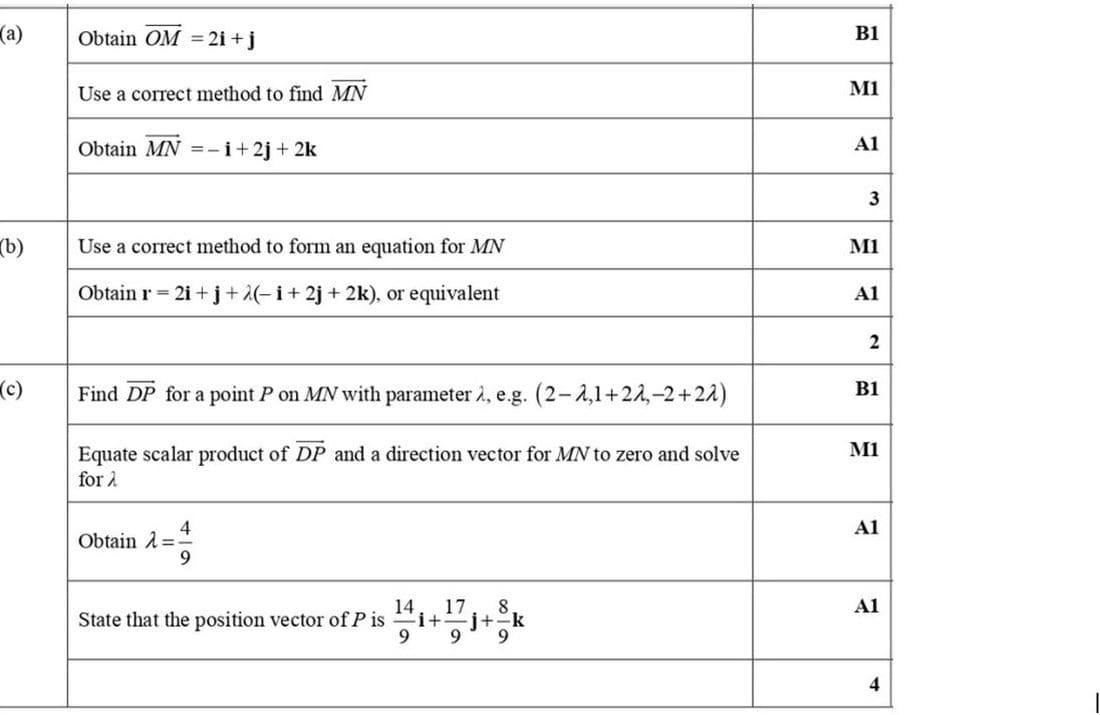
(a) To find \(\overrightarrow{OM}\), note that \(M\) divides \(AB\) in the ratio 1:2. Since \(A = 2\mathbf{i}\) and \(B = 2\mathbf{i} + 3\mathbf{j}\), \(M = 2\mathbf{i} + \frac{1}{3}(3\mathbf{j}) = 2\mathbf{i} + \mathbf{j}\). Thus, \(\overrightarrow{OM} = 2\mathbf{i} + \mathbf{j}\).
For \(\overrightarrow{MN}\), since \(N\) is the midpoint of \(FG\), \(N = 2\mathbf{i} + 3\mathbf{j} + 2\mathbf{k}\). Therefore, \(\overrightarrow{MN} = (2\mathbf{i} + 3\mathbf{j} + 2\mathbf{k}) - (2\mathbf{i} + \mathbf{j}) = -\mathbf{i} + 2\mathbf{j} + 2\mathbf{k}\).
(b) The vector equation of the line through \(M\) and \(N\) is \(\mathbf{r} = 2\mathbf{i} + \mathbf{j} + \lambda(-\mathbf{i} + 2\mathbf{j} + 2\mathbf{k})\), where \(\lambda\) is a parameter.
(c) To find the position vector of \(P\), the foot of the perpendicular from \(D\) to the line through \(M\) and \(N\), we use the fact that \(\overrightarrow{DP}\) is perpendicular to \(\overrightarrow{MN}\). Let \(\overrightarrow{DP} = (2 - \lambda)\mathbf{i} + (1 + 2\lambda)\mathbf{j} + (-2 + 2\lambda)\mathbf{k}\). The dot product \(\overrightarrow{DP} \cdot \overrightarrow{MN} = 0\) gives \(\lambda = \frac{4}{9}\). Substituting \(\lambda\) back, the position vector of \(P\) is \(\frac{14}{9}\mathbf{i} + \frac{17}{9}\mathbf{j} + \frac{8}{9}\mathbf{k}\).