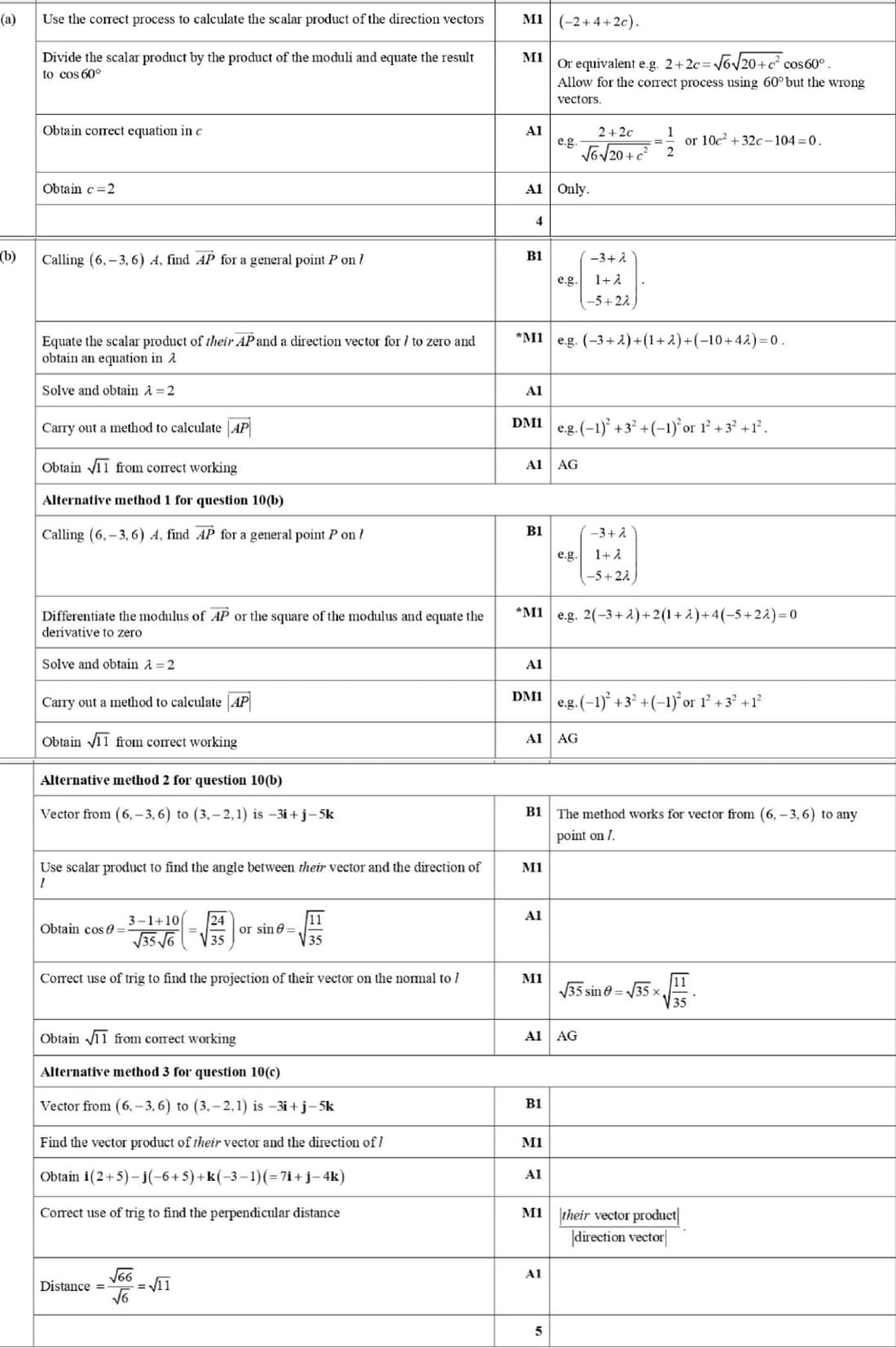
(a) To find the value of c, we use the fact that the angle between the lines is 60°. The direction vectors of l and m are \(\begin{pmatrix} 1 \\ 1 \\ 2 \end{pmatrix}\) and \(\begin{pmatrix} -2 \\ 4 \\ c \end{pmatrix}\) respectively. The cosine of the angle between two vectors \(\mathbf{a}\) and \(\mathbf{b}\) is given by:
\(\cos \theta = \frac{\mathbf{a} \cdot \mathbf{b}}{\|\mathbf{a}\| \|\mathbf{b}\|}\)
Substituting the given vectors and \(\theta = 60^{\circ}\), we have:
\(\cos 60^{\circ} = \frac{1(-2) + 1(4) + 2c}{\sqrt{1^2 + 1^2 + 2^2} \sqrt{(-2)^2 + 4^2 + c^2}}\)
\(\frac{2 + 2c}{\sqrt{6} \sqrt{20 + c^2}} = \frac{1}{2}\)
Solving for c, we get:
\(2 + 2c = \frac{1}{2} \sqrt{120 + 6c^2}\)
\(4 + 4c = \sqrt{120 + 6c^2}\)
Squaring both sides:
\(16 + 16c + 16c^2 = 120 + 6c^2\)
\(10c^2 + 16c - 104 = 0\)
Solving this quadratic equation gives \(c = 2\).
(b) To find the length of the perpendicular from the point (6, -3, 6) to the line l, consider a general point on l given by \(\begin{pmatrix} 3 + \lambda \\ -2 + \lambda \\ 1 + 2\lambda \end{pmatrix}\). The vector from (6, -3, 6) to this point is:
\(\begin{pmatrix} 3 + \lambda - 6 \\ -2 + \lambda + 3 \\ 1 + 2\lambda - 6 \end{pmatrix} = \begin{pmatrix} -3 + \lambda \\ 1 + \lambda \\ -5 + 2\lambda \end{pmatrix}\)
For the perpendicular, the dot product with the direction vector of l must be zero:
\((-3 + \lambda) \cdot 1 + (1 + \lambda) \cdot 1 + (-5 + 2\lambda) \cdot 2 = 0\)
\(-3 + \lambda + 1 + \lambda - 10 + 4\lambda = 0\)
\(6\lambda - 12 = 0\)
\(\lambda = 2\)
The perpendicular vector is \(\begin{pmatrix} -1 \\ 3 \\ -1 \end{pmatrix}\). Its length is:
\(\sqrt{(-1)^2 + 3^2 + (-1)^2} = \sqrt{11}\)