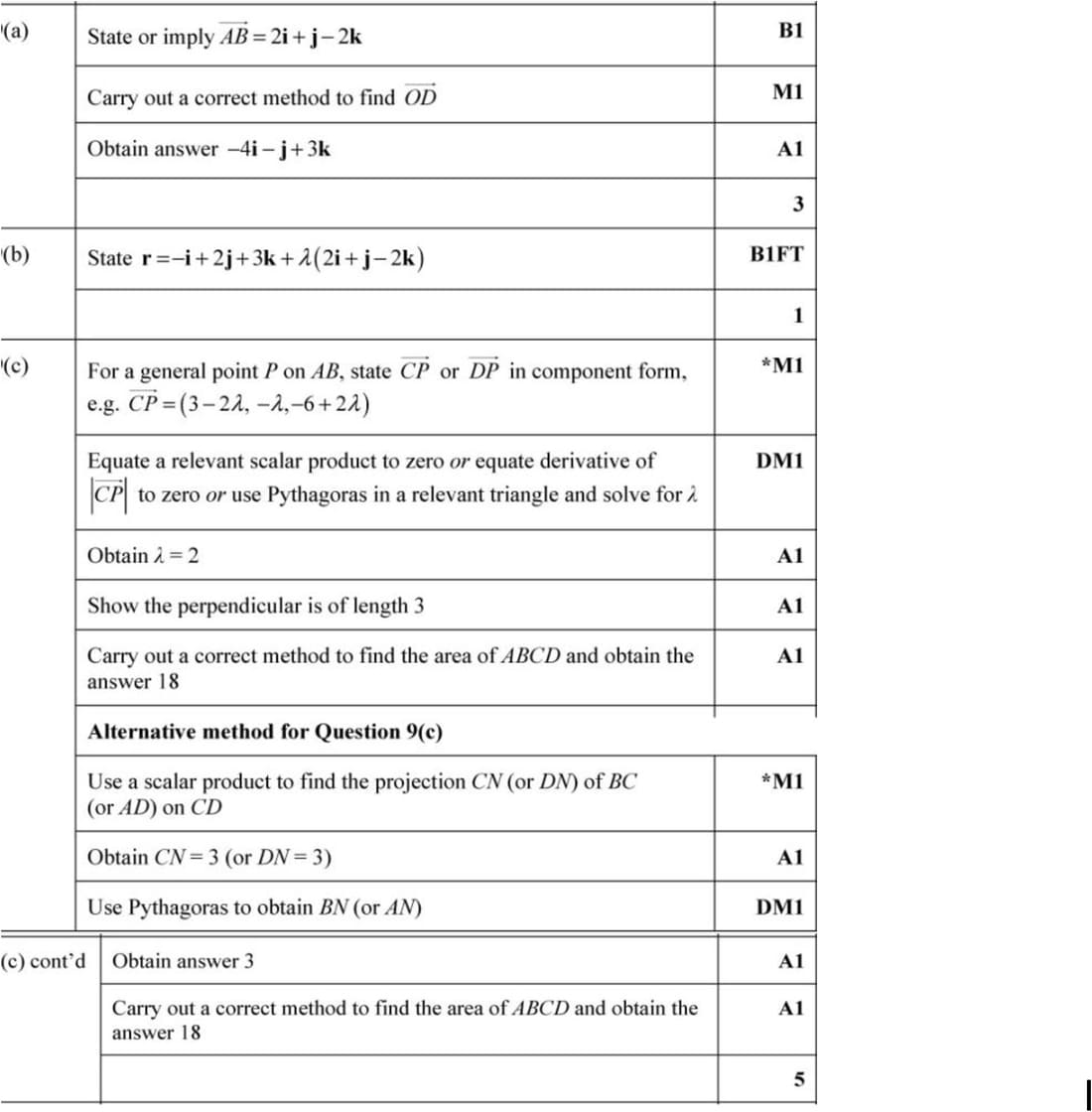
(a) First, find \(\overrightarrow{AB}\):
\(\overrightarrow{AB} = \overrightarrow{OB} - \overrightarrow{OA} = (\mathbf{i} + 3\mathbf{j} + \mathbf{k}) - (-\mathbf{i} + 2\mathbf{j} + 3\mathbf{k}) = 2\mathbf{i} + \mathbf{j} - 2\mathbf{k}\).
Given \(\overrightarrow{DC} = 3\overrightarrow{AB}\), we have:
\(\overrightarrow{DC} = 3(2\mathbf{i} + \mathbf{j} - 2\mathbf{k}) = 6\mathbf{i} + 3\mathbf{j} - 6\mathbf{k}\).
Since \(\overrightarrow{DC} = \overrightarrow{OD} - \overrightarrow{OC}\), we find \(\overrightarrow{OD}\):
\(\overrightarrow{OD} = \overrightarrow{DC} + \overrightarrow{OC} = (6\mathbf{i} + 3\mathbf{j} - 6\mathbf{k}) + (2\mathbf{i} + 2\mathbf{j} - 3\mathbf{k}) = -4\mathbf{i} - \mathbf{j} + 3\mathbf{k}\).
(b) The vector equation for the line through A and B is:
\(\mathbf{r} = -\mathbf{i} + 2\mathbf{j} + 3\mathbf{k} + \lambda(2\mathbf{i} + \mathbf{j} - 2\mathbf{k})\).
(c) To find the distance between the parallel sides, consider the perpendicular distance from C to line AB. The vector \(\overrightarrow{CP}\) is perpendicular to \(\overrightarrow{AB}\), so:
\(\overrightarrow{CP} = (3 - 2\lambda, -\lambda, -6 + 2\lambda)\).
Setting the dot product \(\overrightarrow{CP} \cdot \overrightarrow{AB} = 0\), solve for \(\lambda\):
\((3 - 2\lambda) \cdot 2 + (-\lambda) \cdot 1 + (-6 + 2\lambda) \cdot (-2) = 0\).
Simplifying gives \(\lambda = 2\).
The perpendicular distance is 3.
The area of the trapezium is given by:
\(\text{Area} = \frac{1}{2} \times (\text{Base}_1 + \text{Base}_2) \times \text{Height} = \frac{1}{2} \times (\|\overrightarrow{AB}\| + \|\overrightarrow{DC}\|) \times 3 = 18\).