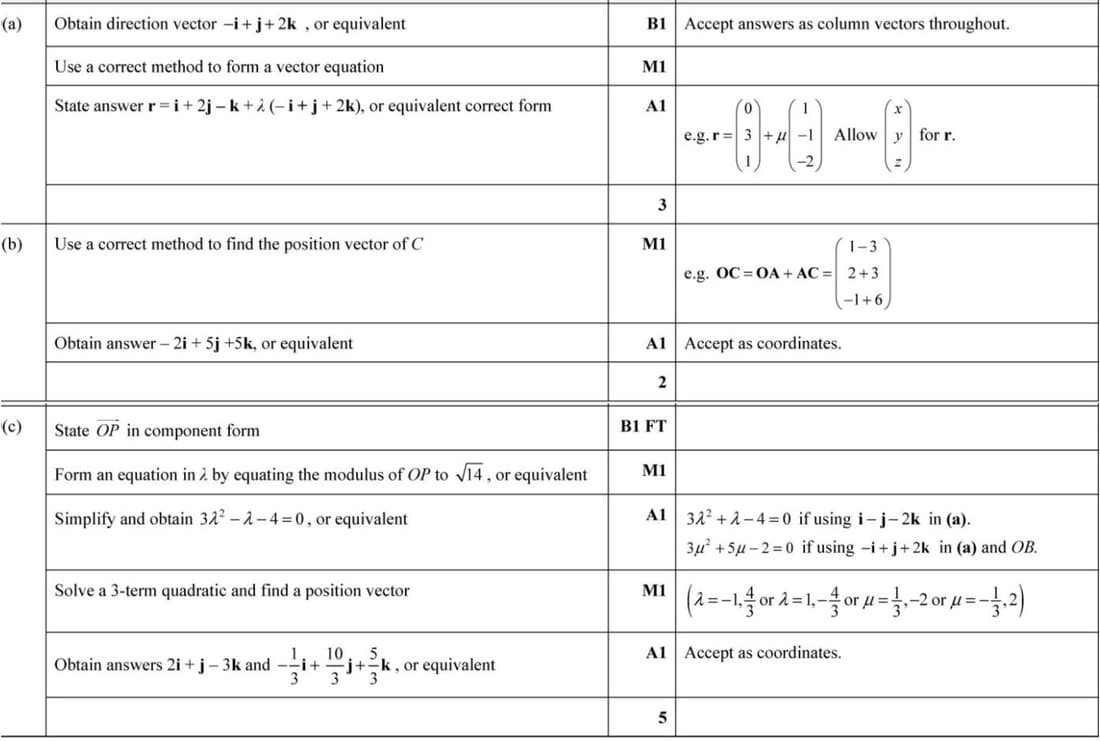
(a) The direction vector \(\overrightarrow{AB}\) is calculated as:
\(\overrightarrow{AB} = \overrightarrow{OB} - \overrightarrow{OA} = \begin{pmatrix} 0 \\ 3 \\ 1 \end{pmatrix} - \begin{pmatrix} 1 \\ 2 \\ -1 \end{pmatrix} = \begin{pmatrix} -1 \\ 1 \\ 2 \end{pmatrix}\)
The vector equation of the line is:
\(\mathbf{r} = \begin{pmatrix} 1 \\ 2 \\ -1 \end{pmatrix} + \lambda \begin{pmatrix} -1 \\ 1 \\ 2 \end{pmatrix}\)
(b) Since \(\overrightarrow{AC} = 3\overrightarrow{AB}\), we have:
\(\overrightarrow{AC} = 3 \begin{pmatrix} -1 \\ 1 \\ 2 \end{pmatrix} = \begin{pmatrix} -3 \\ 3 \\ 6 \end{pmatrix}\)
Thus, \(\overrightarrow{OC} = \overrightarrow{OA} + \overrightarrow{AC} = \begin{pmatrix} 1 \\ 2 \\ -1 \end{pmatrix} + \begin{pmatrix} -3 \\ 3 \\ 6 \end{pmatrix} = \begin{pmatrix} -2 \\ 5 \\ 5 \end{pmatrix}\)
(c) Let \(\overrightarrow{OP} = \begin{pmatrix} 1 \\ 2 \\ -1 \end{pmatrix} + \lambda \begin{pmatrix} -1 \\ 1 \\ 2 \end{pmatrix}\).
The modulus of \(\overrightarrow{OP}\) is \(\sqrt{14}\):
\(\left| \begin{pmatrix} 1 - \lambda \\ 2 + \lambda \\ -1 + 2\lambda \end{pmatrix} \right| = \sqrt{(1 - \lambda)^2 + (2 + \lambda)^2 + (-1 + 2\lambda)^2} = \sqrt{14}\)
Equating and simplifying gives:
\(3\lambda^2 - \lambda - 4 = 0\)
Solving this quadratic equation, we find \(\lambda = -1\) or \(\lambda = \frac{4}{3}\).
Thus, the position vectors are:
For \(\lambda = -1\): \(\overrightarrow{OP} = \begin{pmatrix} 2 \\ 1 \\ -3 \end{pmatrix}\)
For \(\lambda = \frac{4}{3}\): \(\overrightarrow{OP} = \begin{pmatrix} -\frac{1}{3} \\ \frac{10}{3} \\ \frac{5}{3} \end{pmatrix}\)