Nov 2022 p31 q10
2080
Let \(f(x) = \frac{2x^2 + 7x + 8}{(1+x)(2+x)^2}\).
(a) Express \(f(x)\) in partial fractions.
(b) Hence obtain the expansion of \(f(x)\) in ascending powers of \(x\), up to and including the term in \(x^2\).
Solution
(a) Express \(f(x)\) in partial fractions:
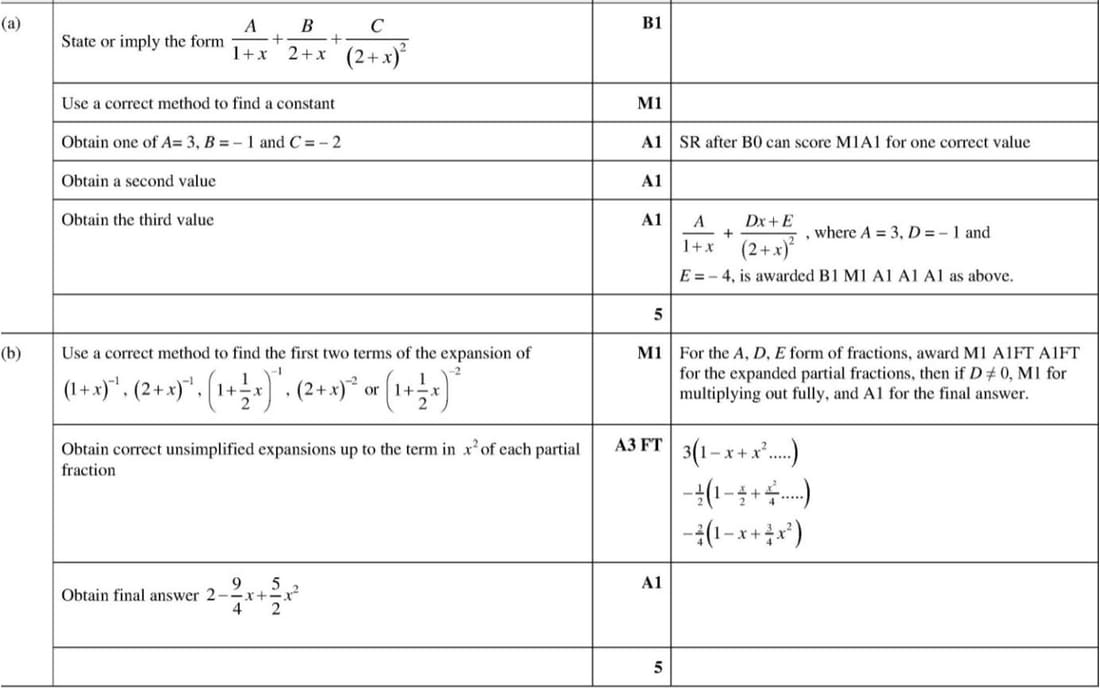
Assume \(\frac{2x^2 + 7x + 8}{(1+x)(2+x)^2} = \frac{A}{1+x} + \frac{B}{2+x} + \frac{C}{(2+x)^2}\).
By equating coefficients, we find \(A = 3\), \(B = -1\), \(C = -2\).
(b) Expand each term:
\(\frac{3}{1+x} = 3(1 - x + x^2 - \ldots)\)
\(\frac{-1}{2+x} = -\frac{1}{2}(1 - \frac{x}{2} + \frac{x^2}{4} - \ldots)\)
\(\frac{-2}{(2+x)^2} = -\frac{2}{4}(1 - x + \frac{x^2}{4} - \ldots)\)
Combine and simplify to get \(2 - \frac{9}{4}x + \frac{5}{2}x^2\).
Log in to record attempts.