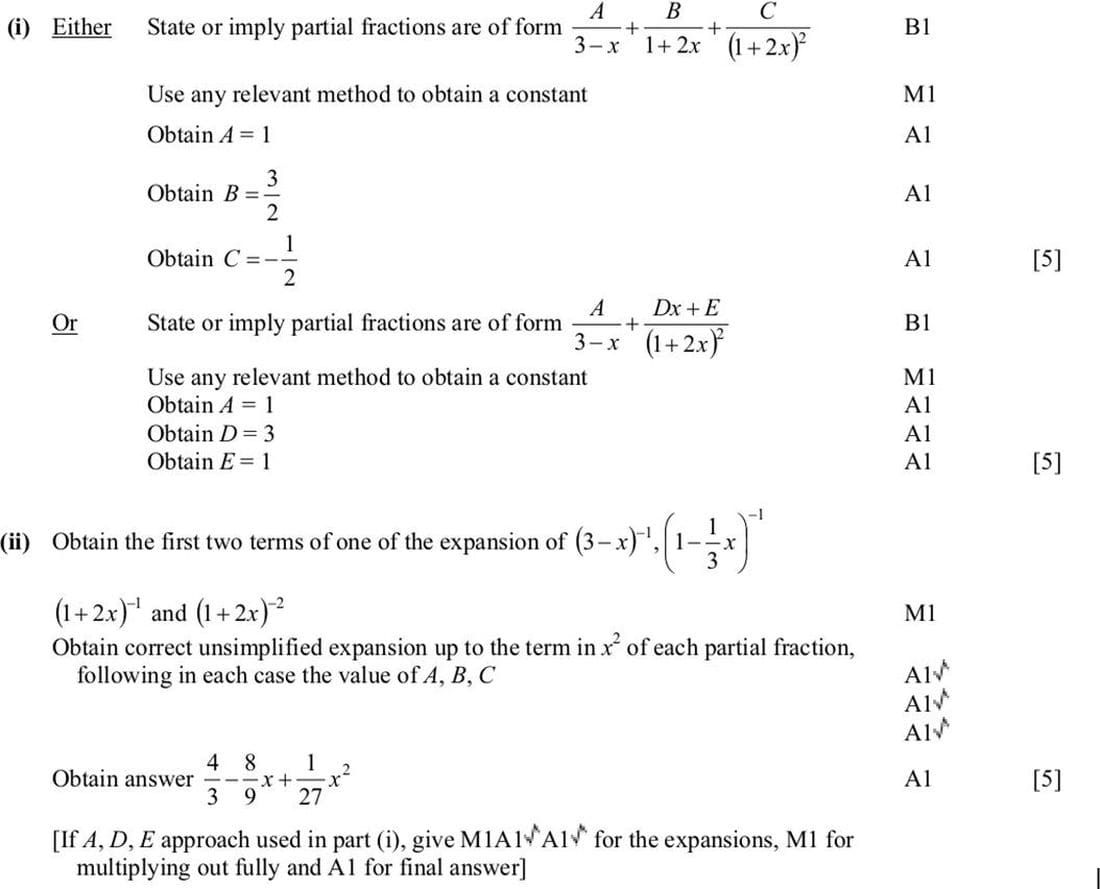
(i) We express \(\frac{4 + 12x + x^2}{(3-x)(1+2x)^2}\) in partial fractions. Assume the form:
\(\frac{A}{3-x} + \frac{B}{1+2x} + \frac{C}{(1+2x)^2}\)
Equating coefficients, we find:
\(A = 1, \ B = \frac{3}{2}, \ C = -\frac{1}{2}\)
(ii) To expand \(\frac{4 + 12x + x^2}{(3-x)(1+2x)^2}\), we first expand \((3-x)^{-1}\) and \((1+2x)^{-2}\):
\((3-x)^{-1} = \frac{1}{3} + \frac{1}{9}x + \cdots\)
\((1+2x)^{-2} = 1 - 4x + 8x^2 + \cdots\)
Using these expansions, we find the expansion of each partial fraction up to \(x^2\):
\(\frac{1}{3} - \frac{1}{9}x + \frac{1}{27}x^2\)
Combining these, we obtain:
\(\frac{4}{3} - \frac{8}{9}x + \frac{1}{27}x^2\)