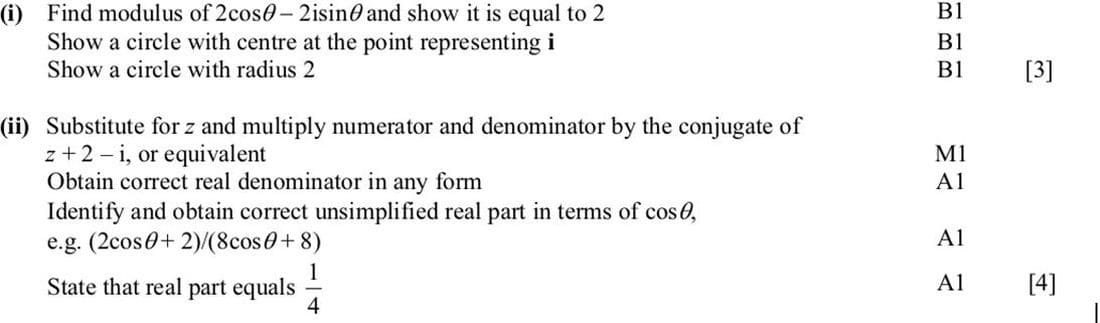
(i) The complex number \(z\) can be rewritten as \(z = 2 \cos \theta + i(1 - 2 \sin \theta)\). To find \(|z - i|\), we have:
\(z - i = 2 \cos \theta + i(1 - 2 \sin \theta - 1) = 2 \cos \theta - 2i \sin \theta\)
The modulus is:
\(|z - i| = \sqrt{(2 \cos \theta)^2 + (-2 \sin \theta)^2} = \sqrt{4 \cos^2 \theta + 4 \sin^2 \theta} = \sqrt{4(\cos^2 \theta + \sin^2 \theta)} = \sqrt{4} = 2\)
Thus, \(|z - i| = 2\) for all \(\theta\), and the locus is a circle with center at \(i\) and radius 2.
(ii) Substitute \(z = 2 \cos \theta + i(1 - 2 \sin \theta)\) into \(\frac{1}{z + 2 - i}\):
\(z + 2 - i = 2 \cos \theta + i(1 - 2 \sin \theta) + 2 - i = (2 \cos \theta + 2) + i(-2 \sin \theta)\)
Multiply numerator and denominator by the conjugate:
\(\frac{1}{z + 2 - i} = \frac{1}{(2 \cos \theta + 2) + i(-2 \sin \theta)} \times \frac{(2 \cos \theta + 2) - i(-2 \sin \theta)}{(2 \cos \theta + 2) - i(-2 \sin \theta)}\)
The denominator becomes:
\((2 \cos \theta + 2)^2 + (2 \sin \theta)^2 = 4 \cos^2 \theta + 8 \cos \theta + 4 + 4 \sin^2 \theta = 8 \cos \theta + 8\)
The real part of the numerator is \(2 \cos \theta + 2\), so the real part of the fraction is:
\(\frac{2 \cos \theta + 2}{8 \cos \theta + 8} = \frac{1}{4}\)
Thus, the real part is constant and equals \(\frac{1}{4}\).