9709 P3 - Nov 2008 - Q10
2014
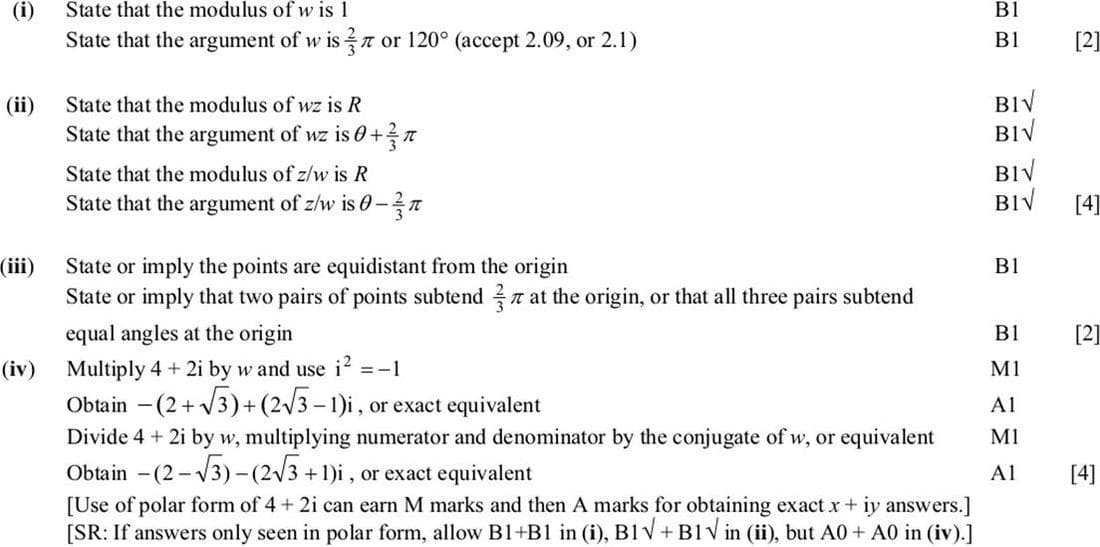
The complex number w is given by \(w = -\frac{1}{2} + i \frac{\sqrt{3}}{2}\).
- Find the modulus and argument of w. [2]
- The complex number z has modulus R and argument \(\theta\), where \(-\frac{1}{3}\pi < \theta < \frac{1}{3}\pi\). State the modulus and argument of wz and the modulus and argument of \(\frac{z}{w}\). [4]
- Hence explain why, in an Argand diagram, the points representing z, wz and \(\frac{z}{w}\) are the vertices of an equilateral triangle. [2]
- In an Argand diagram, the vertices of an equilateral triangle lie on a circle with centre at the origin. One of the vertices represents the complex number 4 + 2i. Find the complex numbers represented by the other two vertices. Give your answers in the form x + iy, where x and y are real and exact. [4]