Browsing as Guest. Progress, bookmarks and attempts are disabled.
Log in to track your work.
Nov 2009 p31 q7
2012
The complex number \(-2 + i\) is denoted by \(u\).
(i) Given that \(u\) is a root of the equation \(x^3 - 11x - k = 0\), where \(k\) is real, find the value of \(k\).
(ii) Write down the other complex root of this equation.
(iii) Find the modulus and argument of \(u\).
(iv) Sketch an Argand diagram showing the point representing \(u\). Shade the region whose points represent the complex numbers \(z\) satisfying both the inequalities \(|z| < |z - 2|\) and \(0 < \arg(z - u) < \frac{1}{4}\pi\).
Solution
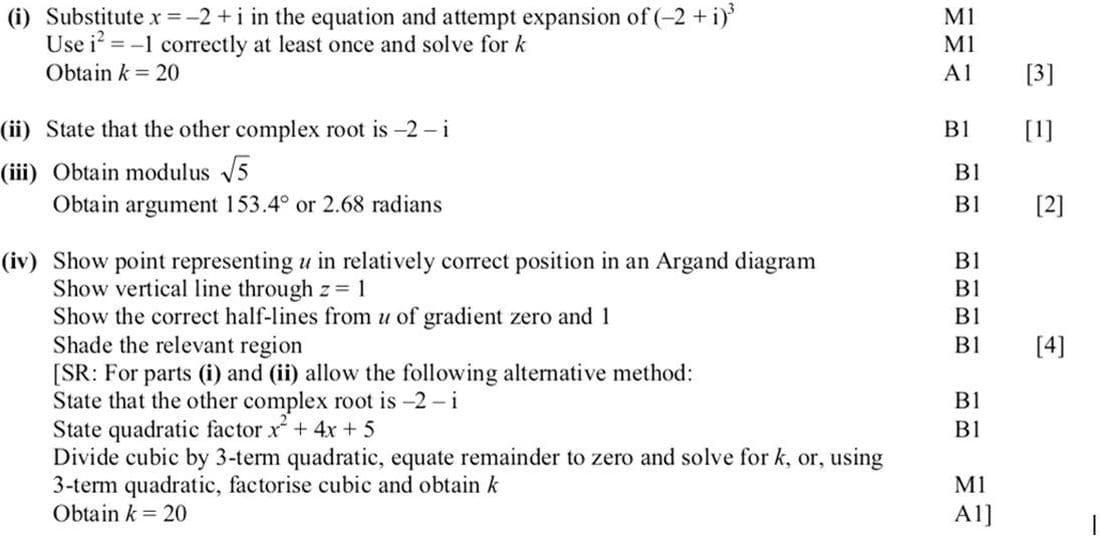
(i) Substitute \(x = -2 + i\) into the equation \(x^3 - 11x - k = 0\). Calculate \((-2 + i)^3\) and use \(i^2 = -1\) to simplify. Solve for \(k\) to obtain \(k = 20\).
(ii) The other complex root is the conjugate of \(-2 + i\), which is \(-2 - i\).
(iii) The modulus of \(u = -2 + i\) is \(\sqrt{(-2)^2 + 1^2} = \sqrt{5}\). The argument is \(\arctan\left(\frac{1}{-2}\right)\), which is approximately \(153.4^\circ\) or \(2.68\) radians.
(iv) On the Argand diagram, plot the point \(-2 + i\). Draw a vertical line through \(z = 1\) and half-lines from \(u\) with gradients 0 and 1. Shade the region satisfying the inequalities \(|z| < |z - 2|\) and \(0 < \arg(z - u) < \frac{1}{4}\pi\).