The complex numbers \(-2 + i\) and \(3 + i\) are denoted by \(u\) and \(v\) respectively.
(i) Find, in the form \(x + iy\), the complex numbers
(a) \(u + v\),
(b) \(\frac{u}{v}\), showing all your working.
(ii) State the argument of \(\frac{u}{v}\).
In an Argand diagram with origin \(O\), the points \(A, B\) and \(C\) represent the complex numbers \(u, v\) and \(u + v\) respectively.
(iii) Prove that angle \(AOB = \frac{3}{4}\pi\).
(iv) State fully the geometrical relationship between the line segments \(OA\) and \(BC\).
Solution
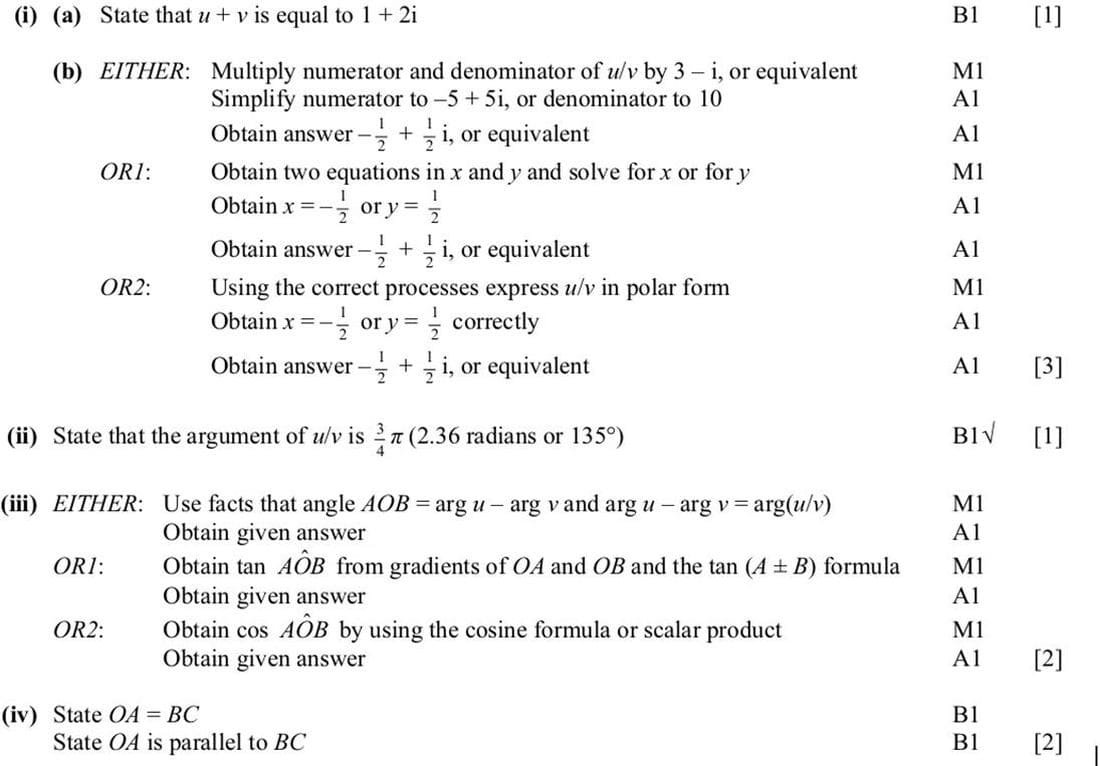
(i) (a) To find \(u + v\), add the real and imaginary parts of \(u = -2 + i\) and \(v = 3 + i\):
\((-2 + 3) + (1 + 1)i = 1 + 2i\).
(b) To find \(\frac{u}{v}\), multiply numerator and denominator by the conjugate of \(v\):
\(\frac{-2 + i}{3 + i} \times \frac{3 - i}{3 - i} = \frac{(-2 + i)(3 - i)}{(3 + i)(3 - i)}\).
Calculate the numerator: \((-2)(3) + (-2)(-i) + i(3) + i(-i) = -6 + 2i + 3i - 1 = -7 + 5i\).
Calculate the denominator: \(3^2 - i^2 = 9 + 1 = 10\).
Thus, \(\frac{u}{v} = \frac{-7 + 5i}{10} = -\frac{7}{10} + \frac{5}{10}i = -\frac{1}{2} + \frac{1}{2}i\).
(ii) The argument of \(\frac{u}{v}\) is \(\frac{3}{4}\pi\) as given.
(iii) Use the fact that angle \(AOB = \text{arg}(u) - \text{arg}(v) = \text{arg}\left(\frac{u}{v}\right) = \frac{3}{4}\pi\).
(iv) Since \(u + v\) is the vector sum of \(u\) and \(v\), \(OA = BC\) and \(OA\) is parallel to \(BC\).
Log in to record attempts.