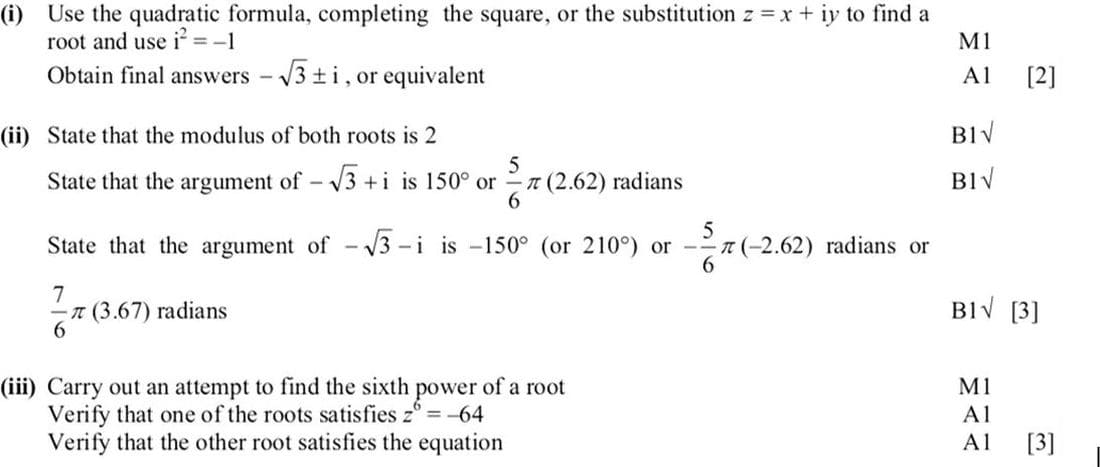
(i) To find the roots of the equation \(z^2 + (2\sqrt{3})z + 4 = 0\), we use the quadratic formula:
\(z = \frac{-b \pm \sqrt{b^2 - 4ac}}{2a}\)
where \(a = 1\), \(b = 2\sqrt{3}\), and \(c = 4\).
\(z = \frac{-(2\sqrt{3}) \pm \sqrt{(2\sqrt{3})^2 - 4 \cdot 1 \cdot 4}}{2 \cdot 1}\)
\(z = \frac{-2\sqrt{3} \pm \sqrt{12 - 16}}{2}\)
\(z = \frac{-2\sqrt{3} \pm \sqrt{-4}}{2}\)
\(z = \frac{-2\sqrt{3} \pm 2i}{2}\)
\(z = -\sqrt{3} \pm i\)
(ii) The modulus of each root \(z = x + iy\) is given by \(|z| = \sqrt{x^2 + y^2}\).
For \(z = -\sqrt{3} + i\), \(|z| = \sqrt{(-\sqrt{3})^2 + 1^2} = \sqrt{3 + 1} = 2\).
The argument of \(-\sqrt{3} + i\) is \(\arctan\left(\frac{1}{-\sqrt{3}}\right) = 150^\circ\) or \(\frac{5}{6}\pi\) radians.
For \(z = -\sqrt{3} - i\), \(|z| = \sqrt{(-\sqrt{3})^2 + (-1)^2} = 2\).
The argument of \(-\sqrt{3} - i\) is \(\arctan\left(\frac{-1}{-\sqrt{3}}\right) = -150^\circ\) or \(-\frac{5}{6}\pi\) radians.
(iii) To verify that each root satisfies \(z^6 = -64\), we calculate \((-\sqrt{3} + i)^6\) and \((-\sqrt{3} - i)^6\).
Using De Moivre's Theorem, \((re^{i\theta})^n = r^n e^{in\theta}\).
For \(z = -\sqrt{3} + i\), \(r = 2\) and \(\theta = 150^\circ\).
\(z^6 = 2^6 e^{i(6 \times 150^\circ)} = 64 e^{i900^\circ} = 64 e^{i180^\circ} = 64(-1) = -64\).
For \(z = -\sqrt{3} - i\), \(r = 2\) and \(\theta = -150^\circ\).
\(z^6 = 2^6 e^{i(6 \times -150^\circ)} = 64 e^{-i900^\circ} = 64 e^{-i180^\circ} = 64(-1) = -64\).
Both roots satisfy \(z^6 = -64\).