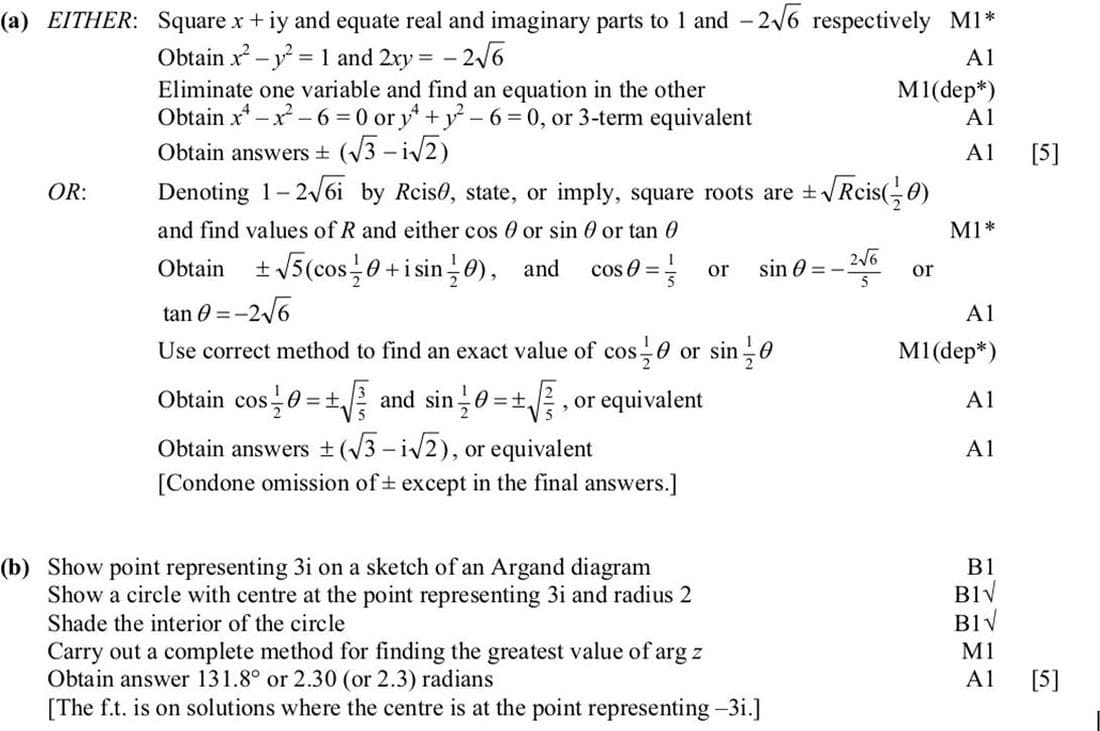
(a) To find the square roots of the complex number \(1 - 2\sqrt{6}i\), denote the square root as \(x + iy\). Then, \((x + iy)^2 = 1 - 2\sqrt{6}i\).
Equate real and imaginary parts: \(x^2 - y^2 = 1\) and \(2xy = -2\sqrt{6}\).
From \(2xy = -2\sqrt{6}\), we have \(xy = -\sqrt{6}\).
Substitute \(y = -\frac{\sqrt{6}}{x}\) into \(x^2 - y^2 = 1\):
\(x^2 - \left(-\frac{\sqrt{6}}{x}\right)^2 = 1\)
\(x^2 - \frac{6}{x^2} = 1\)
Multiply through by \(x^2\):
\(x^4 - 6 = x^2\)
\(x^4 - x^2 - 6 = 0\)
Let \(u = x^2\), then \(u^2 - u - 6 = 0\).
Factorize: \((u - 3)(u + 2) = 0\)
\(u = 3\) or \(u = -2\) (discard \(u = -2\) as \(x^2\) cannot be negative).
\(x^2 = 3\), so \(x = \pm \sqrt{3}\).
Substitute back to find \(y\):
\(y = -\frac{\sqrt{6}}{x} = -\frac{\sqrt{6}}{\pm \sqrt{3}} = \mp \sqrt{2}\).
Thus, the square roots are \(\pm (\sqrt{3} - i\sqrt{2})\).
(b) The inequality \(|z - 3i| \leq 2\) represents a circle centered at \(3i\) with radius 2 on the Argand diagram.
Shade the interior of this circle.
The greatest value of \(\arg z\) occurs at the topmost point of the circle, which is at \(3 + 2i\).
Calculate \(\arg(3 + 2i)\):
\(\arctan\left(\frac{2}{3}\right)\)
\(\arg z = 131.8^\circ\) or \(2.30\) radians.