June 2012 p31 q4
1999
โ
The complex number u is defined by \(u = \frac{(1 + 2i)^2}{2 + i}\).
Without using a calculator and showing your working, express u in the form x + iy , where x and y are real. Sketch an Argand diagram showing the locus of the complex number z such that \(|z-u| = |u|\).
๐ Show/Hide Solution
๐งพ Show/Hide Mark Scheme
Solution
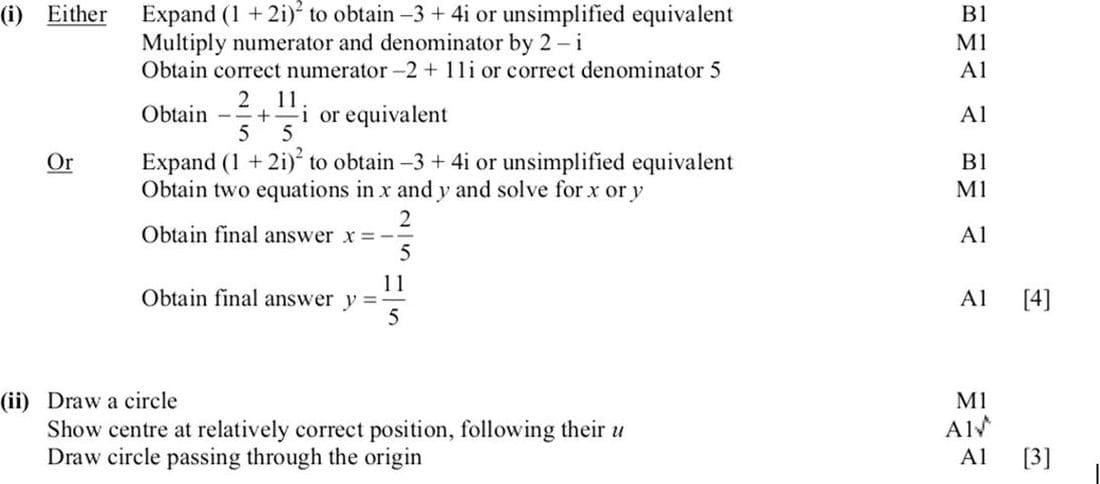
(i) First, expand \((1 + 2i)^2\):
\((1 + 2i)^2 = 1 + 4i + 4i^2 = 1 + 4i - 4 = -3 + 4i\).
Now, divide by \(2 + i\) by multiplying the numerator and denominator by the conjugate \(2 - i\):
\(\frac{-3 + 4i}{2 + i} \times \frac{2 - i}{2 - i} = \frac{(-3 + 4i)(2 - i)}{(2 + i)(2 - i)}\).
The denominator is:
\((2 + i)(2 - i) = 4 + 1 = 5\).
The numerator is:
\((-3 + 4i)(2 - i) = -6 + 3i + 8i - 4i^2 = -6 + 11i + 4 = -2 + 11i\).
Thus, \(u = \frac{-2 + 11i}{5} = -\frac{2}{5} + \frac{11}{5}i\).
(ii) The locus \(|z-u| = |u|\) represents a circle centered at \(u\) with radius \(|u|\). Since \(u = -\frac{2}{5} + \frac{11}{5}i\), the circle is centered at this point and passes through the origin.
Log in to record attempts.