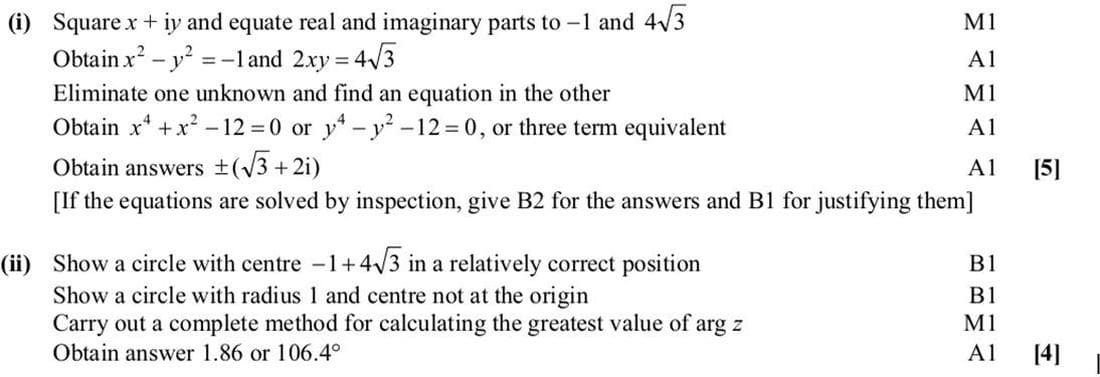
(i) Let the square root of u be x + iy. Then, \((x + iy)^2 = -1 + 4\sqrt{3}i\).
Equate real and imaginary parts: \(x^2 - y^2 = -1\) and \(2xy = 4\sqrt{3}\).
From \(2xy = 4\sqrt{3}\), we have \(xy = 2\sqrt{3}\).
Substitute \(y = \frac{2\sqrt{3}}{x}\) into \(x^2 - y^2 = -1\):
\(x^2 - \left(\frac{2\sqrt{3}}{x}\right)^2 = -1\)
\(x^2 - \frac{12}{x^2} = -1\)
Multiply through by \(x^2\):
\(x^4 + x^2 - 12 = 0\)
Solving this quadratic in \(x^2\), we find \(x^2 = 3\) or \(x^2 = -4\).
Thus, \(x = \pm \sqrt{3}\) and \(y = \pm 2\).
The square roots are \(\pm (\sqrt{3} + 2i)\).
(ii) The locus \(|z - u| = 1\) is a circle with center \(-1 + 4\sqrt{3}i\) and radius 1.
The greatest value of \(arg z\) occurs when \(z\) is at the top of the circle.
Calculate the angle from the origin to the top of the circle: \(\arctan\left(\frac{4\sqrt{3} + 1}{-1}\right)\).
Using the mark scheme, the greatest value of \(arg z\) is approximately 1.86 or 106.4°.