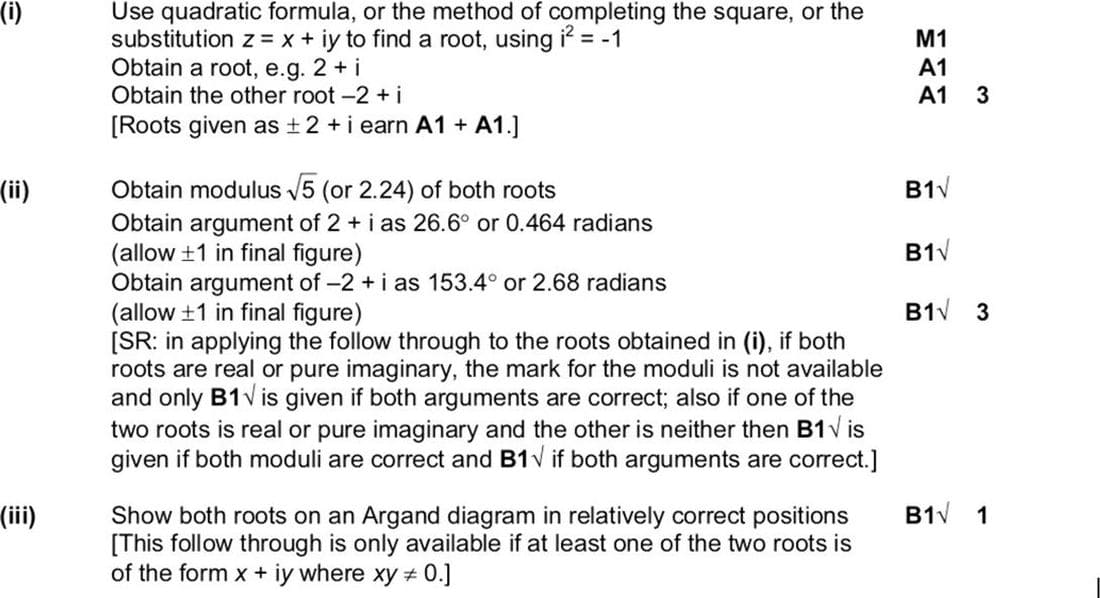
(i) To solve \(z^2 - 2iz - 5 = 0\), use the quadratic formula \(z = \frac{-b \pm \sqrt{b^2 - 4ac}}{2a}\) where \(a = 1\), \(b = -2i\), and \(c = -5\).
Calculate the discriminant: \(b^2 - 4ac = (-2i)^2 - 4(1)(-5) = -4 - (-20) = 16\).
Thus, \(z = \frac{2i \pm \sqrt{16}}{2} = \frac{2i \pm 4}{2}\).
The roots are \(z = 2 + i\) and \(z = -2 + i\).
(ii) The modulus of each root \(z = x + iy\) is \(\sqrt{x^2 + y^2}\).
For \(z = 2 + i\), modulus is \(\sqrt{2^2 + 1^2} = \sqrt{5}\).
For \(z = -2 + i\), modulus is also \(\sqrt{5}\).
The argument of \(z = 2 + i\) is \(\arctan(\frac{1}{2}) \approx 26.6^\circ\).
The argument of \(z = -2 + i\) is \(180^\circ - \arctan(\frac{1}{2}) \approx 153.4^\circ\).
(iii) Plot the points \((2, 1)\) and \((-2, 1)\) on the Argand diagram, representing the roots \(z = 2 + i\) and \(z = -2 + i\).