Browsing as Guest. Progress, bookmarks and attempts are disabled.
Log in to track your work.
Nov 2005 p3 q7
1911
The equation \(2x^3 + x^2 + 25 = 0\) has one real root and two complex roots.
Verify that \(1 + 2i\) is one of the complex roots.
Write down the other complex root of the equation.
Sketch an Argand diagram showing the point representing the complex number \(1 + 2i\). Show on the same diagram the set of points representing the complex numbers \(z\) which satisfy \(|z| = |z - 1 - 2i|\).
Solution
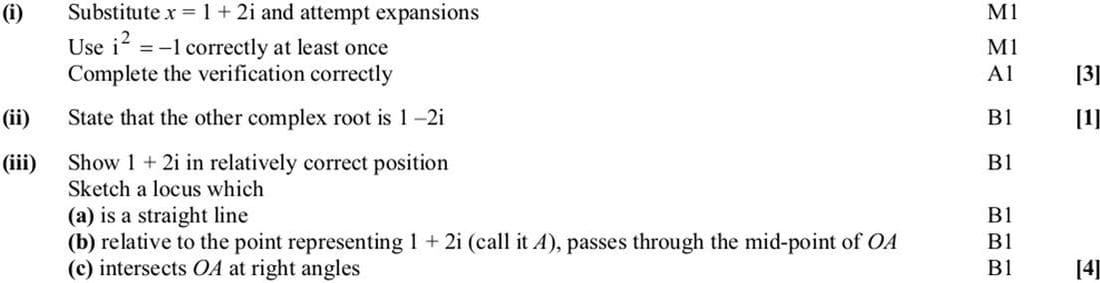
(i) To verify that \(1 + 2i\) is a root, substitute \(x = 1 + 2i\) into the equation \(2x^3 + x^2 + 25 = 0\).
(ii) Since the coefficients of the polynomial are real, the complex roots occur in conjugate pairs. Therefore, the other complex root is \(1 - 2i\).
(iii) On the Argand diagram, plot the point \(1 + 2i\). The equation \(|z| = |z - 1 - 2i|\) represents the perpendicular bisector of the line segment joining the origin \(O\) and the point \(A = 1 + 2i\). This is a straight line passing through the midpoint of \(OA\) and intersecting \(OA\) at right angles.