Browsing as Guest. Progress, bookmarks and attempts are disabled.
Log in to track your work.
9709 P3 - Jun 2007 - Q8
1908
The complex number \(\frac{2}{-1+i}\) is denoted by \(u\).
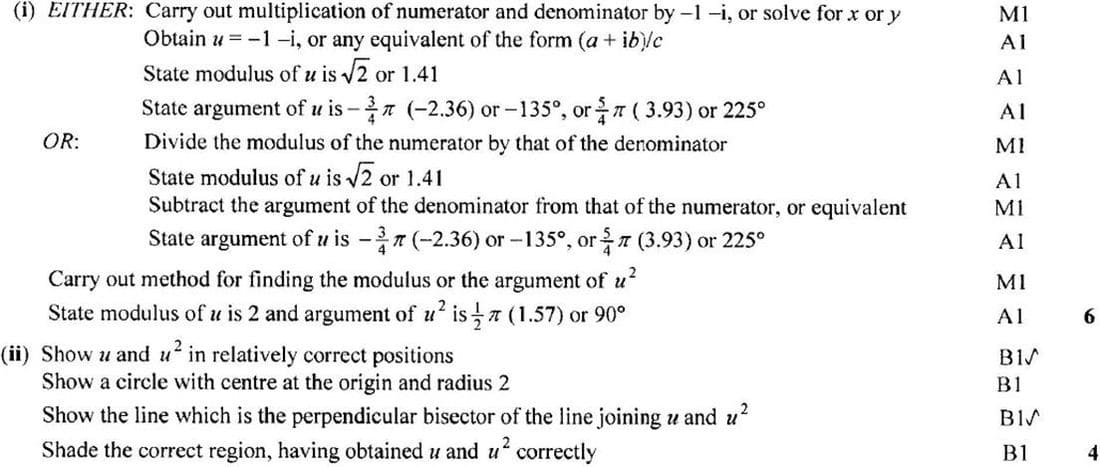
(i) Find the modulus and argument of \(u\) and \(u^2\).
(ii) Sketch an Argand diagram showing the points representing the complex numbers \(u\) and \(u^2\). Shade the region whose points represent the complex numbers \(z\) which satisfy both the inequalities \(|z| < 2\) and \(|z-u^2| < |z-u|\).
Solution
To find \(u\), multiply the numerator and denominator by the conjugate of the denominator:
The modulus of \(u\) is \(|u| = \sqrt{(-1)^2 + (-1)^2} = \sqrt{2}\).
The argument of \(u\) is \(\text{arg}(u) = \arctan\left(\frac{-1}{-1}\right) = -\frac{3}{4}\pi\) or \(-135^\circ\).
For \(u^2\):
\(u^2 = (-1-i)^2 = 1 + 2i + i^2 = -1 - 2i\)
The modulus of \(u^2\) is \(|u^2| = \sqrt{(-1)^2 + (-2)^2} = \sqrt{5}\).
The argument of \(u^2\) is \(\text{arg}(u^2) = \arctan\left(\frac{-2}{-1}\right) = \frac{1}{2}\pi\) or \(90^\circ\).
For the Argand diagram, plot \(u = -1-i\) and \(u^2 = -1-2i\). Draw a circle centered at the origin with radius 2. The line \(|z-u^2| < |z-u|\) is the perpendicular bisector of the line segment joining \(u\) and \(u^2\). Shade the region inside the circle and on the side of the bisector closer to \(u^2\).