Browsing as Guest. Progress, bookmarks and attempts are disabled.
Log in to track your work.
June 2005 p3 q7
1895
(i) By sketching a suitable pair of graphs, show that the equation \(\csc x = \frac{1}{2}x + 1\), where \(x\) is in radians, has a root in the interval \(0 < x < \frac{1}{2}\pi\).
(ii) Verify, by calculation, that this root lies between 0.5 and 1.
(iii) Show that this root also satisfies the equation \(x = \sin^{-1} \left( \frac{2}{x+2} \right)\).
(iv) Use the iterative formula \(x_{n+1} = \sin^{-1} \left( \frac{2}{x_n+2} \right)\), with initial value \(x_1 = 0.75\), to determine this root correct to 2 decimal places. Give the result of each iteration to 4 decimal places.
Solution
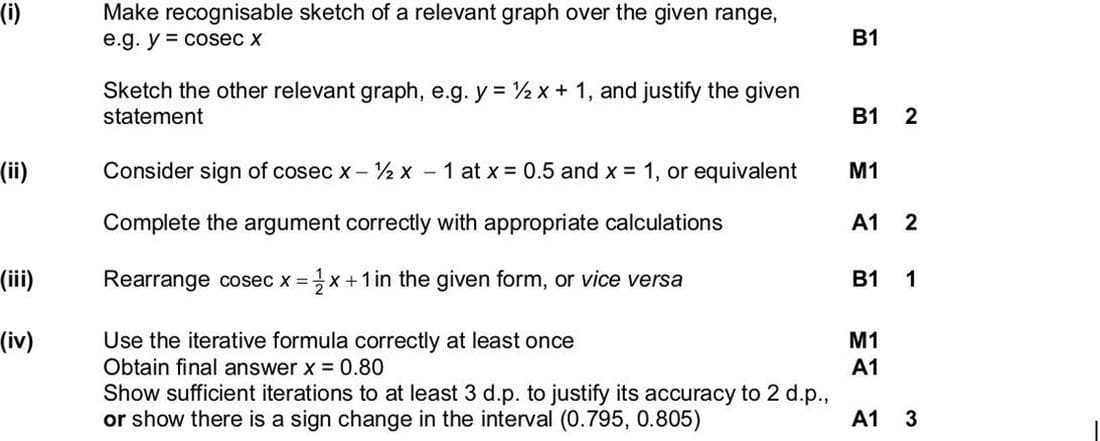
(i) Sketch the graphs of \(y = \csc x\) and \(y = \frac{1}{2}x + 1\) over the interval \(0 < x < \frac{1}{2}\pi\). The intersection of these graphs indicates a root in this interval.
(ii) Evaluate \(\csc x - \frac{1}{2}x - 1\) at \(x = 0.5\) and \(x = 1\). If the signs are different, a root exists between these values.
(iii) Rearrange \(\csc x = \frac{1}{2}x + 1\) to \(x = \sin^{-1} \left( \frac{2}{x+2} \right)\) to show equivalence.
(iv) Use the iterative formula \(x_{n+1} = \sin^{-1} \left( \frac{2}{x_n+2} \right)\) starting with \(x_1 = 0.75\). Calculate successive iterations until the value stabilizes to 2 decimal places: \(x_2 = 0.8041\), \(x_3 = 0.8002\), \(x_4 = 0.8000\). The root is approximately 0.80.