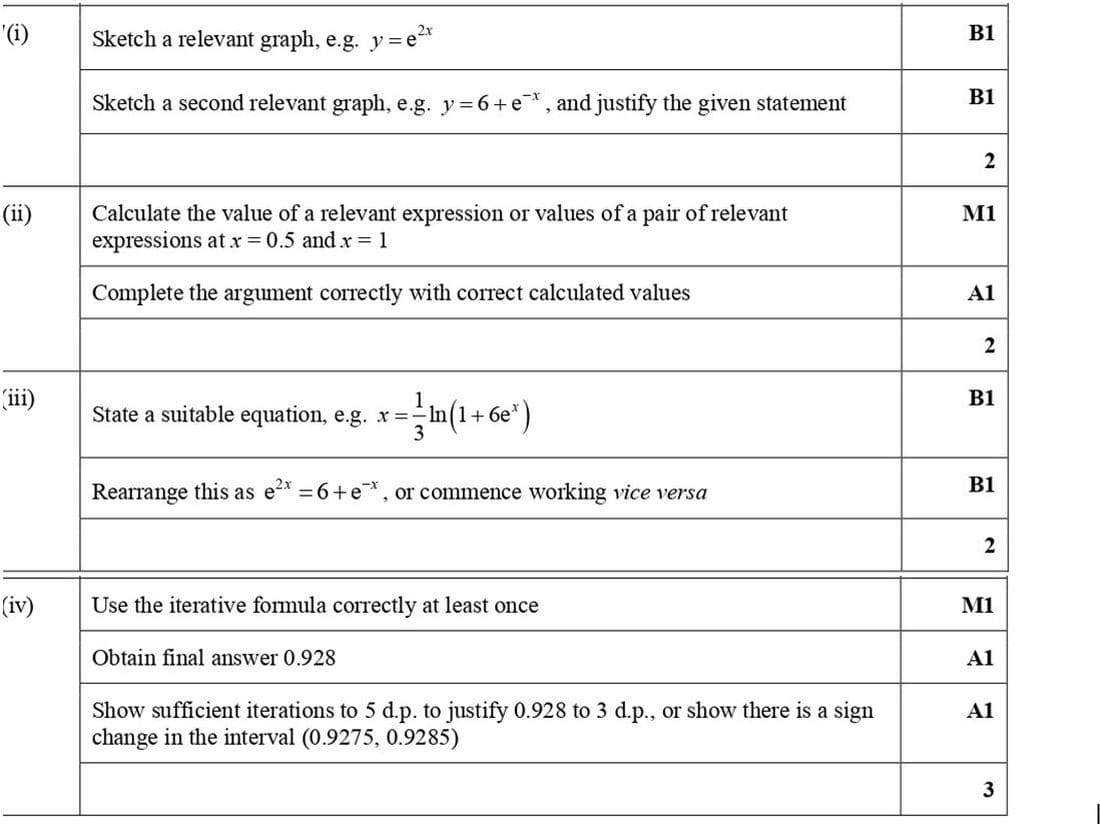
(i) Sketch the graphs of \(y = e^{2x}\) and \(y = 6 + e^{-x}\). The intersection of these graphs represents the solution to the equation \(e^{2x} = 6 + e^{-x}\). The graphs intersect at exactly one point, indicating one real root.
(ii) Calculate \(e^{2(0.5)} = e \approx 2.718\) and \(6 + e^{-0.5} \approx 6.606\). Since \(e^{2(0.5)} < 6 + e^{-0.5}\), check \(x = 1\): \(e^{2(1)} = e^2 \approx 7.389\) and \(6 + e^{-1} \approx 6.368\). Since \(e^{2(1)} > 6 + e^{-1}\), the root lies between 0.5 and 1.
(iii) The iterative formula \(x_{n+1} = \frac{1}{3} \ln(1 + 6e^{x_n})\) is derived from rearranging the original equation. If the sequence converges, it converges to the root of \(e^{2x} = 6 + e^{-x}\).
(iv) Using the iterative formula, start with an initial guess, say \(x_0 = 0.5\):
\(x_1 = \frac{1}{3} \ln(1 + 6e^{0.5}) \approx 0.91894\)
\(x_2 = \frac{1}{3} \ln(1 + 6e^{0.91894}) \approx 0.92754\)
\(x_3 = \frac{1}{3} \ln(1 + 6e^{0.92754}) \approx 0.92823\)
\(x_4 = \frac{1}{3} \ln(1 + 6e^{0.92823}) \approx 0.92828\)
\(x_5 = \frac{1}{3} \ln(1 + 6e^{0.92828}) \approx 0.92828\)
The root correct to 3 decimal places is 0.928.