Problem #1875
Metadata not filled yet
1875
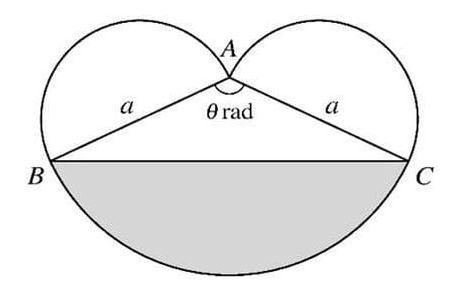
The diagram shows a triangle ABC in which AB = AC = a and angle BAC = \theta radians. Semicircles are drawn outside the triangle with AB and AC as diameters. A circular arc with centre A joins B and C. The area of the shaded segment is equal to the sum of the areas of the semicircles.
- Show that \(\theta = \frac{1}{2}\pi + \sin \theta\).
- Verify by calculation that \(\theta\) lies between 2.2 and 2.4.
- Use an iterative formula based on the equation in part (i) to determine \(\theta\) correct to 2 decimal places. Give the result of each iteration to 4 decimal places.
Solutions locked. Please sign in with access to view them.