9709 P3 - Jun 2007 - Q6
1869
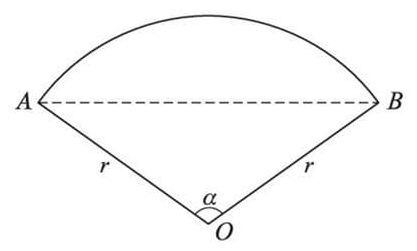
The diagram shows a sector AOB of a circle with centre O and radius r. The angle AOB is \(\alpha\) radians, where \(0 < \alpha < \pi\). The area of triangle AOB is half the area of the sector.
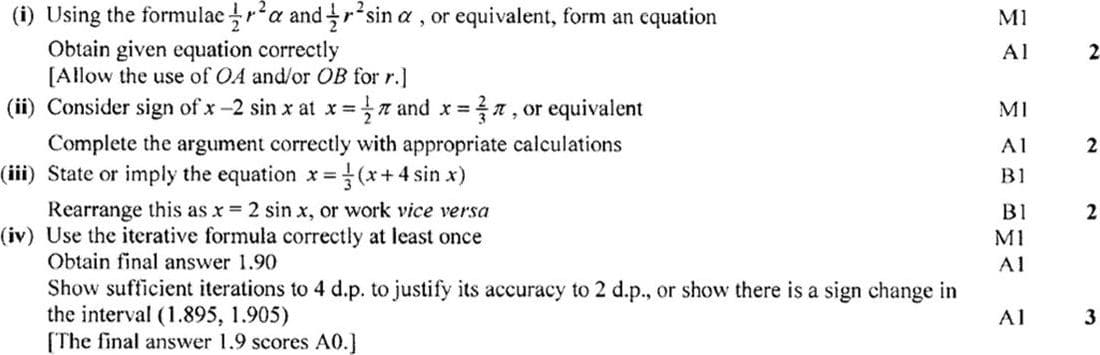
- Show that \(\alpha\) satisfies the equation \(x = 2 \sin x\).
- Verify by calculation that \(\alpha\) lies between \(\frac{1}{2} \pi\) and \(\frac{2}{3} \pi\).
- Show that, if a sequence of values given by the iterative formula \(x_{n+1} = \frac{1}{3}(x_n + 4 \sin x_n)\) converges, then it converges to a root of the equation in part (i).
- Use this iterative formula, with initial value \(x_1 = 1.8\), to find \(\alpha\) correct to 2 decimal places. Give the result of each iteration to 4 decimal places.