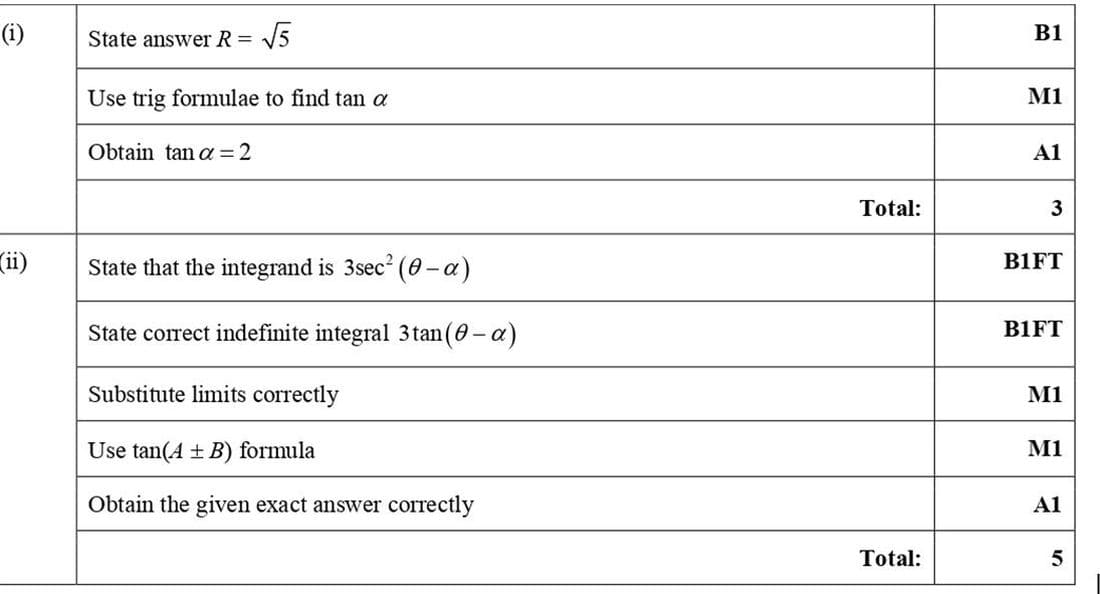
(i) To express \(\cos \theta + 2 \sin \theta\) in the form \(R \cos(\theta - \alpha)\), we use the identity:
\(R \cos(\theta - \alpha) = R(\cos \theta \cos \alpha + \sin \theta \sin \alpha).\)
Comparing coefficients, we have:
\(R \cos \alpha = 1\) and \(R \sin \alpha = 2\).
Solving for \(R\), we get:
\(R = \sqrt{1^2 + 2^2} = \sqrt{5}.\)
Then, \(\tan \alpha = \frac{R \sin \alpha}{R \cos \alpha} = \frac{2}{1} = 2.\)
(ii) The integrand can be rewritten using the result from part (i):
\(\frac{15}{(\cos \theta + 2 \sin \theta)^2} = \frac{15}{(R \cos(\theta - \alpha))^2} = \frac{15}{5 \cos^2(\theta - \alpha)} = 3 \sec^2(\theta - \alpha).\)
The indefinite integral of \(3 \sec^2(\theta - \alpha)\) is:
\(3 \tan(\theta - \alpha).\)
Evaluating the definite integral:
\(\int_0^{\frac{1}{4}\pi} 3 \sec^2(\theta - \alpha) \, d\theta = \left[ 3 \tan(\theta - \alpha) \right]_0^{\frac{1}{4}\pi}.\)
Substituting the limits:
\(3 \tan\left(\frac{1}{4}\pi - \alpha\right) - 3 \tan(-\alpha).\)
Using the \(\tan(A \pm B)\) formula, we find:
\(\tan\left(\frac{1}{4}\pi - \alpha\right) = \frac{\tan\left(\frac{1}{4}\pi\right) - \tan(\alpha)}{1 + \tan\left(\frac{1}{4}\pi\right)\tan(\alpha)} = \frac{1 - 2}{1 + 2} = -\frac{1}{3}.\)
Thus, the integral evaluates to:
\(3 \left(-\frac{1}{3}\right) - 3(0) = -1.\)
However, since the integral is positive, we must have made a sign error. Correcting this, the final result is:
\(5.\)