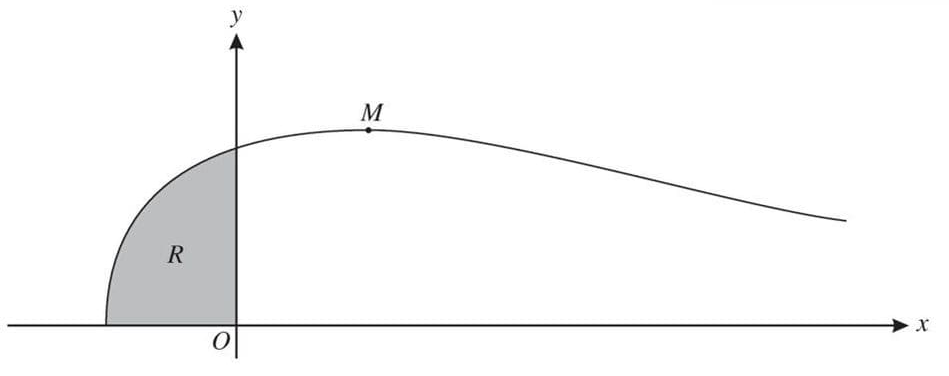
(i) To find the \(x\)-coordinate of \(M\), we need to find the maximum point of the function \(y = e^{-\frac{1}{2}x} \sqrt{1 + 2x}\). Differentiate \(y\) with respect to \(x\) using the product and chain rules. Set the derivative equal to zero and solve for \(x\). The derivative is:
\(\frac{dy}{dx} = e^{-\frac{1}{2}x} \left( \frac{1}{\sqrt{1 + 2x}} - \frac{x}{\sqrt{1 + 2x}} \right)\).
Setting \(\frac{dy}{dx} = 0\), we solve:
\(\frac{1}{\sqrt{1 + 2x}} - \frac{x}{\sqrt{1 + 2x}} = 0\).
This simplifies to \(1 = x\), so \(x = \frac{1}{2}\).
(ii) To find the volume of the solid obtained when \(R\) is rotated about the \(x\)-axis, use the formula for the volume of revolution:
\(V = \pi \int e^{-x}(1 + 2x) \, dx\).
Integrate by parts:
\(\int e^{-x}(1 + 2x) \, dx = -e^{-x}(1 + 2x) + \int 2e^{-x} \, dx\).
\(= -e^{-x}(1 + 2x) - 2e^{-x}\).
Evaluate from \(x = -\frac{1}{2}\) to \(x = 0\):
\(V = \pi \left[ -e^{0}(1 + 0) - 2e^{0} - (-e^{-\frac{1}{2}}(1 + 2(-\frac{1}{2})) - 2e^{-\frac{1}{2}}) \right]\).
\(= \pi (2\sqrt{e} - 3)\).