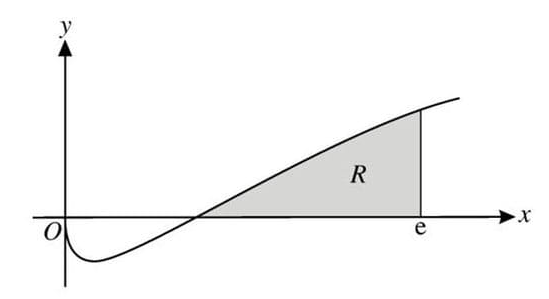
(i) To find the equation of the tangent, we first need the derivative of \(y = x^{\frac{1}{2}} \ln x\). Using the product rule, \(\frac{d}{dx}(x^{\frac{1}{2}} \ln x) = \ln x \cdot \frac{1}{2}x^{-\frac{1}{2}} + x^{\frac{1}{2}} \cdot \frac{1}{x} = \frac{\ln x}{2\sqrt{x}} + \frac{1}{\sqrt{x}}\).
At \(x = 1\), the derivative becomes \(\frac{\ln 1}{2} + 1 = 1\).
The point on the curve at \(x = 1\) is \((1, 0)\) since \(y = 1^{\frac{1}{2}} \ln 1 = 0\).
The equation of the tangent is \(y - 0 = 1(x - 1)\), which simplifies to \(y = x - 1\).
(ii) The volume of the solid obtained by rotating the region \(R\) about the x-axis is given by \(\pi \int_1^e (x^{\frac{1}{2}} \ln x)^2 \, dx\).
Using integration by parts, let \(u = (\ln x)^2\) and \(dv = x \, dx\). Then \(du = 2 \ln x \cdot \frac{1}{x} \, dx\) and \(v = \frac{x^2}{2}\).
Integrating by parts, we have \(\frac{1}{2} x^2 (\ln x)^2 - \int x \ln x \, dx\).
For the second integral, use integration by parts again with \(u = \ln x\) and \(dv = x \, dx\). Then \(du = \frac{1}{x} \, dx\) and \(v = \frac{x^2}{2}\).
This gives \(\frac{1}{2} x^2 \ln x - \frac{1}{4} x^2\).
Substituting back, the integral becomes \(\frac{1}{2} x^2 (\ln x)^2 - \frac{1}{2} x^2 \ln x + \frac{1}{4} x^2\).
Evaluating from \(x = 1\) to \(x = e\), we get \(\frac{1}{4} \pi (e^2 - 1)\).