June 2014 p33 q9
1795
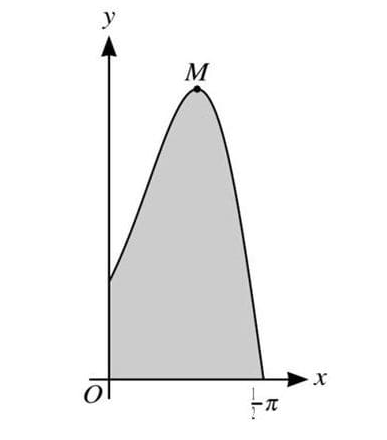
The diagram shows the curve \(y = e^{2\sin x} \cos x\) for \(0 \leq x \leq \frac{1}{2}\pi\), and its maximum point \(M\).
(i) Using the substitution \(u = \sin x\), find the exact value of the area of the shaded region bounded by the curve and the axes.
(ii) Find the \(x\)-coordinate of \(M\), giving your answer correct to 3 decimal places.
Solution
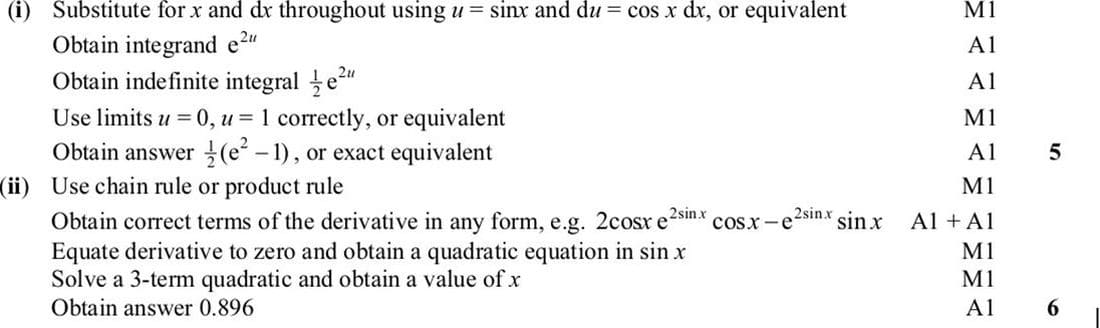
(i) Substitute \(u = \sin x\) and \(du = \cos x \, dx\). The integrand becomes \(e^{2u}\).
The indefinite integral is \(\frac{1}{2} e^{2u}\).
Using limits \(u = 0\) and \(u = 1\), the definite integral is \(\frac{1}{2}(e^2 - 1)\).
(ii) Use the chain rule or product rule to find the derivative: \(2\cos x \, e^{2\sin x} \cos x - e^{2\sin x} \sin x\).
Equate the derivative to zero and solve the quadratic equation in \(\sin x\).
Solve the 3-term quadratic to find \(x = 0.896\).
Log in to record attempts.