Browsing as Guest. Progress, bookmarks and attempts are disabled.
Log in to track your work.
June 2017 p31 q10
1794
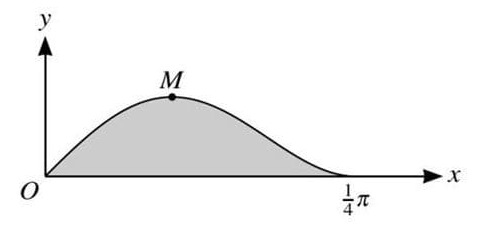
The diagram shows the curve \(y = \\sin x \\cos^2 2x\) for \(0 \leq x \leq \frac{1}{4} \pi\) and its maximum point \(M\).
(i) Using the substitution \(u = \\cos x\), find by integration the exact area of the shaded region bounded by the curve and the \(x\)-axis.
(ii) Find the \(x\)-coordinate of \(M\). Give your answer correct to 2 decimal places.
Solution
(i) Let \(u = \\cos x\), then \(du = -\\sin x \, dx\). The integral becomes \(\int \\sin x \\cos^2 2x \, dx\). Using the double angle formula, express \(\\cos 2x = 2u^2 - 1\). The integrand becomes \((2u^2 - 1)^2\). Change limits: when \(x = 0, u = 1\) and when \(x = \frac{1}{4}\pi, u = \frac{1}{\sqrt{2}}\). The integral is \(\int_{1/\sqrt{2}}^1 (2u^2 - 1)^2 \, du\). Substitute limits in an integral of the form \(au^5 + bu^3 + cu\) to obtain \(\frac{1}{15}(7 - 4\sqrt{2})\).
(ii) Differentiate \(y = \\sin x \\cos^2 2x\) using the product rule and chain rule. Set the derivative to zero and solve for \(x\). Use trigonometric identities to obtain \(10\\cos^2 x = 9\) or \(10\\sin^2 x = 1\). Solve to find \(x = 0.32\).