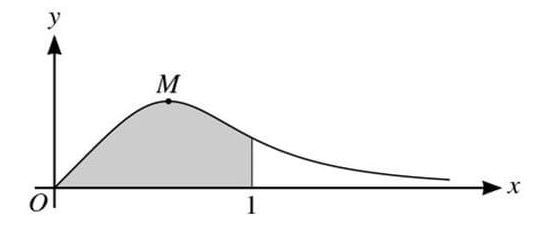
(a) To find the \(x\)-coordinate of \(M\), we need to find the maximum point of the function \(y = \frac{x}{1 + 3x^4}\). We use the quotient rule to differentiate:
\(\frac{d}{dx} \left( \frac{x}{1 + 3x^4} \right) = \frac{(1 + 3x^4) \cdot 1 - x \cdot 12x^3}{(1 + 3x^4)^2} = \frac{1 + 3x^4 - 12x^4}{(1 + 3x^4)^2} = \frac{1 - 9x^4}{(1 + 3x^4)^2}\).
Set the derivative to zero to find critical points:
\(1 - 9x^4 = 0\)
\(9x^4 = 1\)
\(x^4 = \frac{1}{9}\)
\(x = \left( \frac{1}{9} \right)^{1/4} = \frac{1}{3^{1/2}} = \frac{1}{\sqrt{3}} \approx 0.577\).
(b) To find the area under the curve from \(x = 0\) to \(x = 1\), we use the substitution \(u = \sqrt{3}x^2\), so \(du = 2\sqrt{3}x \, dx\), or \(dx = \frac{du}{2\sqrt{3}x}\).
Substitute \(x = \frac{u}{\sqrt{3}}\) into the integral:
\(\int_0^1 \frac{x}{1 + 3x^4} \, dx = \int_0^{\sqrt{3}} \frac{\frac{u}{\sqrt{3}}}{1 + u^2} \cdot \frac{du}{2\sqrt{3}x}\).
Since \(x = \frac{u}{\sqrt{3}}\), the integral becomes:
\(\int_0^{\sqrt{3}} \frac{1}{2\sqrt{3}(1 + u^2)} \, du\).
This is a standard integral of the form \(\frac{1}{a} \arctan(u)\), where \(a = 1\):
\(\frac{1}{2\sqrt{3}} \left[ \arctan(u) \right]_0^{\sqrt{3}} = \frac{1}{2\sqrt{3}} \left( \arctan(\sqrt{3}) - \arctan(0) \right)\).
\(\arctan(\sqrt{3}) = \frac{\pi}{3}\), so the area is:
\(\frac{1}{2\sqrt{3}} \cdot \frac{\pi}{3} = \frac{\sqrt{3}\pi}{18}\).