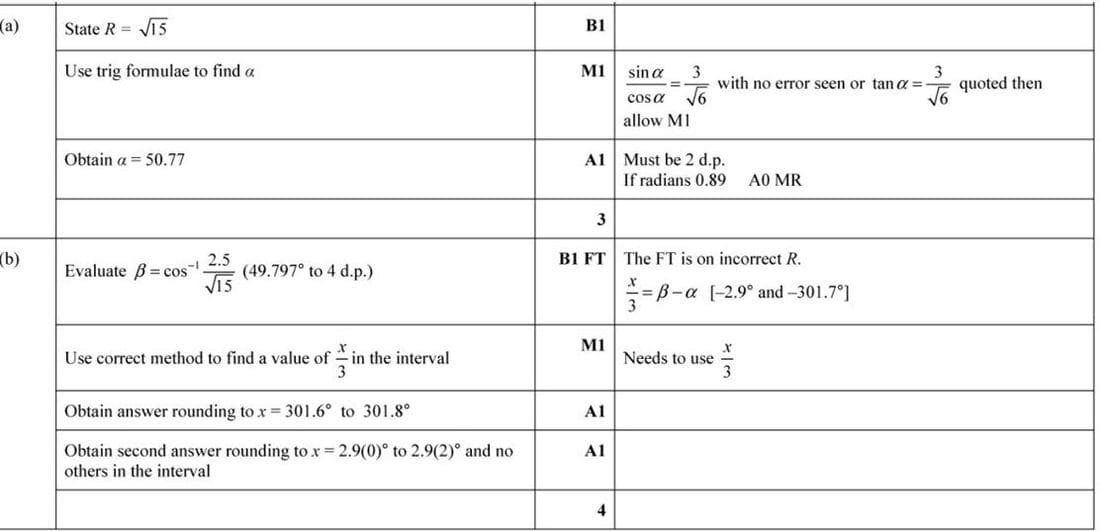
(a) We need to express \(\sqrt{6} \cos \theta + 3 \sin \theta\) in the form \(R \cos(\theta - \alpha)\).
Using the identity:
\(a \cos \theta + b \sin \theta \equiv R \cos(\theta - \alpha)\)
where \(R = \sqrt{a^2 + b^2}\) and \(\tan \alpha = \frac{b}{a}\).
Here, \(a = \sqrt{6}\) and \(b = 3\).
Calculate \(R\):
\(R = \sqrt{(\sqrt{6})^2 + 3^2} = \sqrt{6 + 9} = \sqrt{15}\)
Calculate \(\alpha\):
\(\tan \alpha = \frac{3}{\sqrt{6}} = \frac{3}{\sqrt{6}}\)
\(\alpha = \tan^{-1}\left(\frac{3}{\sqrt{6}}\right) \approx 50.77^\circ\)
(b) Solve \(\sqrt{6} \cos \frac{1}{3}x + 3 \sin \frac{1}{3}x = 2.5\).
Using the result from part (a), we have:
\(\sqrt{15} \cos\left(\frac{1}{3}x - 50.77^\circ\right) = 2.5\)
\(\cos\left(\frac{1}{3}x - 50.77^\circ\right) = \frac{2.5}{\sqrt{15}}\)
Let \(\beta = \cos^{-1}\left(\frac{2.5}{\sqrt{15}}\right) \approx 49.797^\circ\).
Then:
\(\frac{1}{3}x - 50.77^\circ = 49.797^\circ\)
\(\frac{1}{3}x = 49.797^\circ + 50.77^\circ\)
\(x = 3(49.797^\circ + 50.77^\circ) \approx 301.7^\circ\)
For the second solution:
\(\frac{1}{3}x - 50.77^\circ = -49.797^\circ\)
\(\frac{1}{3}x = -49.797^\circ + 50.77^\circ\)
\(x = 3(-49.797^\circ + 50.77^\circ) \approx 2.9^\circ\)