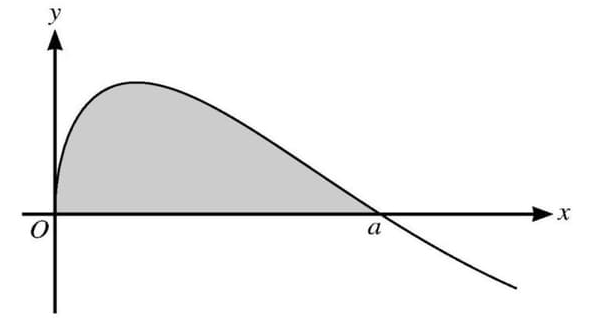
(a) To find the value of \(a\), we set \(y = 0\) in the equation \(y = \\sin \\sqrt{x}\). This gives \(\\sin \\sqrt{x} = 0\), which implies \(\\sqrt{x} = n\\pi\) for some integer \(n\). The smallest positive \(x\) occurs when \(\\sqrt{x} = \\pi\), so \(x = \\pi^2\). Thus, \(a = \\pi^2\).
(b) We use the substitution \(u = \\sqrt{x}\), which implies \(x = u^2\) and \(dx = 2u \, du\). The integral becomes:
\(\\int_0^{\\pi} \\sin u \, 2u \, du\)
Using integration by parts, let \(v = u\) and \(dw = \\sin u \, du\), then \(dv = du\) and \(w = -\\cos u\). The integration by parts formula \(\\int v \, dw = vw - \\int w \, dv\) gives:
\(-u \\cos u + \\int \\cos u \, du\)
The integral of \(\\cos u\) is \(\\sin u\), so the expression becomes:
\(-u \\cos u + \\sin u\)
Evaluating from \(u = 0\) to \(u = \\pi\):
\([-\\pi \\cos \\pi + \\sin \\pi] - [0 \\cos 0 + \\sin 0] = -\\pi(-1) + 0 = \\pi\)
Thus, the area is \(2\\pi\).