Browsing as Guest. Progress, bookmarks and attempts are disabled.
Log in to track your work.
June 2005 p3 q9
1783
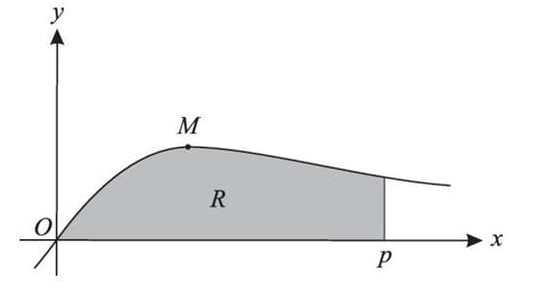
The diagram shows part of the curve \(y = \frac{x}{x^2 + 1}\) and its maximum point \(M\). The shaded region \(R\) is bounded by the curve and by the lines \(y = 0\) and \(x = p\).
Calculate the \(x\)-coordinate of \(M\).
Find the area of \(R\) in terms of \(p\).
Hence calculate the value of \(p\) for which the area of \(R\) is 1, giving your answer correct to 3 significant figures.
Solution
(i) To find the \(x\)-coordinate of \(M\), we differentiate \(y = \frac{x}{x^2 + 1}\) using the quotient rule: \(\frac{d}{dx}\left(\frac{x}{x^2 + 1}\right) = \frac{(x^2 + 1) \cdot 1 - x \cdot 2x}{(x^2 + 1)^2} = \frac{x^2 + 1 - 2x^2}{(x^2 + 1)^2} = \frac{1 - x^2}{(x^2 + 1)^2}\).
Setting the derivative to zero gives \(1 - x^2 = 0\), so \(x = 1\).
(ii) The area \(R\) is given by the integral \(\int_0^p \frac{x}{x^2 + 1} \, dx\). Using substitution \(u = x^2 + 1\), \(du = 2x \, dx\), the integral becomes \(\frac{1}{2} \int_1^{p^2 + 1} \frac{1}{u} \, du = \frac{1}{2} [\ln(u)]_1^{p^2 + 1} = \frac{1}{2} \ln(p^2 + 1)\).
(iii) To find \(p\) such that the area is 1, solve \(\frac{1}{2} \ln(p^2 + 1) = 1\). This gives \(\ln(p^2 + 1) = 2\), so \(p^2 + 1 = e^2\). Therefore, \(p^2 = e^2 - 1\) and \(p = \sqrt{e^2 - 1} \approx 2.53\).