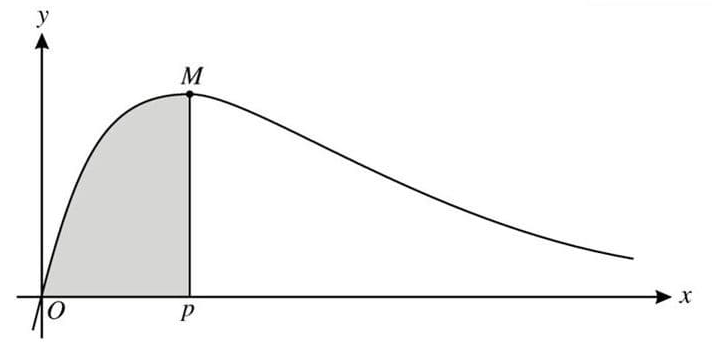
(i) To find the maximum point \(M\), we need to find the derivative of the function \(y = e^{-x} - e^{-2x}\) and set it to zero.
The derivative is \(\frac{dy}{dx} = -e^{-x} - (-2)e^{-2x} = -e^{-x} + 2e^{-2x}\).
Setting the derivative to zero gives:
\(-e^{-x} + 2e^{-2x} = 0\)
\(e^{-x} = 2e^{-2x}\)
\(e^{x} = 2\)
\(x = \ln 2\)
Thus, \(p = \ln 2\).
(ii) To find the area of the shaded region, we need to integrate the function from \(x = 0\) to \(x = p\).
The indefinite integral of \(y = e^{-x} - e^{-2x}\) is:
\(\int (e^{-x} - e^{-2x}) \, dx = -e^{-x} - \left(-\frac{1}{2}\right)e^{-2x} = -e^{-x} + \frac{1}{2}e^{-2x}\)
Evaluating from \(x = 0\) to \(x = \ln 2\):
\(\left[-e^{-x} + \frac{1}{2}e^{-2x}\right]_0^{\ln 2} = \left(-e^{-\ln 2} + \frac{1}{2}e^{-2\ln 2}\right) - \left(-e^{0} + \frac{1}{2}e^{0}\right)\)
\(= \left(-\frac{1}{2} + \frac{1}{2}\left(\frac{1}{4}\right)\right) - \left(-1 + \frac{1}{2}\right)\)
\(= \left(-\frac{1}{2} + \frac{1}{8}\right) - \left(-\frac{1}{2}\right)\)
\(= -\frac{1}{2} + \frac{1}{8} + \frac{1}{2}\)
\(= \frac{1}{8}\)
Thus, the area is \(\frac{1}{8}\).