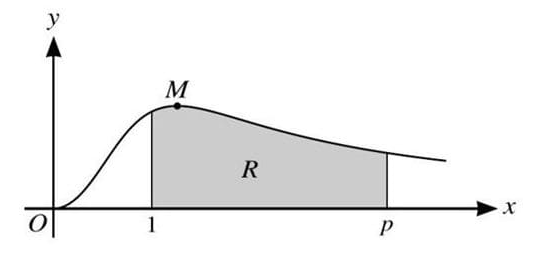
(i) To find the \(x\)-coordinate of the maximum point \(M\), we first find the derivative of \(y = \frac{x^2}{1 + x^3}\) using the quotient rule. The derivative is:
\(\frac{d}{dx} \left( \frac{x^2}{1 + x^3} \right) = \frac{(1 + x^3)(2x) - x^2(3x^2)}{(1 + x^3)^2}\)
Simplifying, we get:
\(\frac{2x + 2x^4 - 3x^4}{(1 + x^3)^2} = \frac{2x - x^4}{(1 + x^3)^2}\)
Setting the derivative equal to zero to find critical points:
\(2x - x^4 = 0\)
\(x(2 - x^3) = 0\)
\(x = 0\) or \(x^3 = 2\)
Since \(x > 0\), we have \(x = \sqrt[3]{2}\).
(ii) To find \(p\) such that the area of \(R\) is 1, we calculate the definite integral of \(y = \frac{x^2}{1 + x^3}\) from 1 to \(p\):
\(\int_1^p \frac{x^2}{1 + x^3} \, dx = \left[ \frac{1}{3} \ln(1 + x^3) \right]_1^p\)
\(= \frac{1}{3} \ln(1 + p^3) - \frac{1}{3} \ln(2)\)
Setting the area equal to 1:
\(\frac{1}{3} \ln(1 + p^3) - \frac{1}{3} \ln(2) = 1\)
\(\ln(1 + p^3) = 3 + \ln(2)\)
\(1 + p^3 = e^{3 + \ln(2)}\)
\(p^3 = e^{3 + \ln(2)} - 1\)
Solving for \(p\), we find \(p \approx 3.40\) to 3 significant figures.