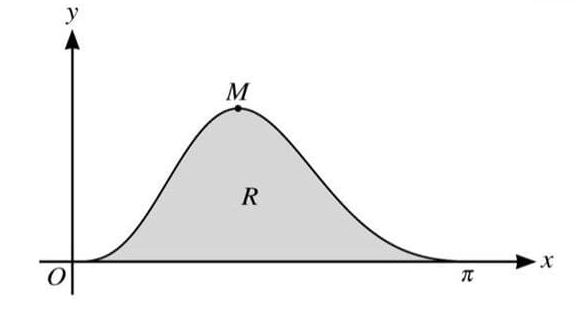
(i) To find the \(x\)-coordinate of \(M\), we need to find the maximum of \(y = e^{\cos x} \sin^3 x\). Differentiate using the product rule and chain rule:
\(\frac{dy}{dx} = e^{\cos x} \left( -\sin x \sin^3 x + 3\cos x \sin^2 x \right)\).
Set \(\frac{dy}{dx} = 0\) to find critical points:
\(-\sin x \sin^3 x + 3\cos x \sin^2 x = 0\).
Factor out \(\sin^2 x\):
\(\sin^2 x (-\sin x + 3\cos x) = 0\).
Thus, \(\sin x = 0\) or \(-\sin x + 3\cos x = 0\).
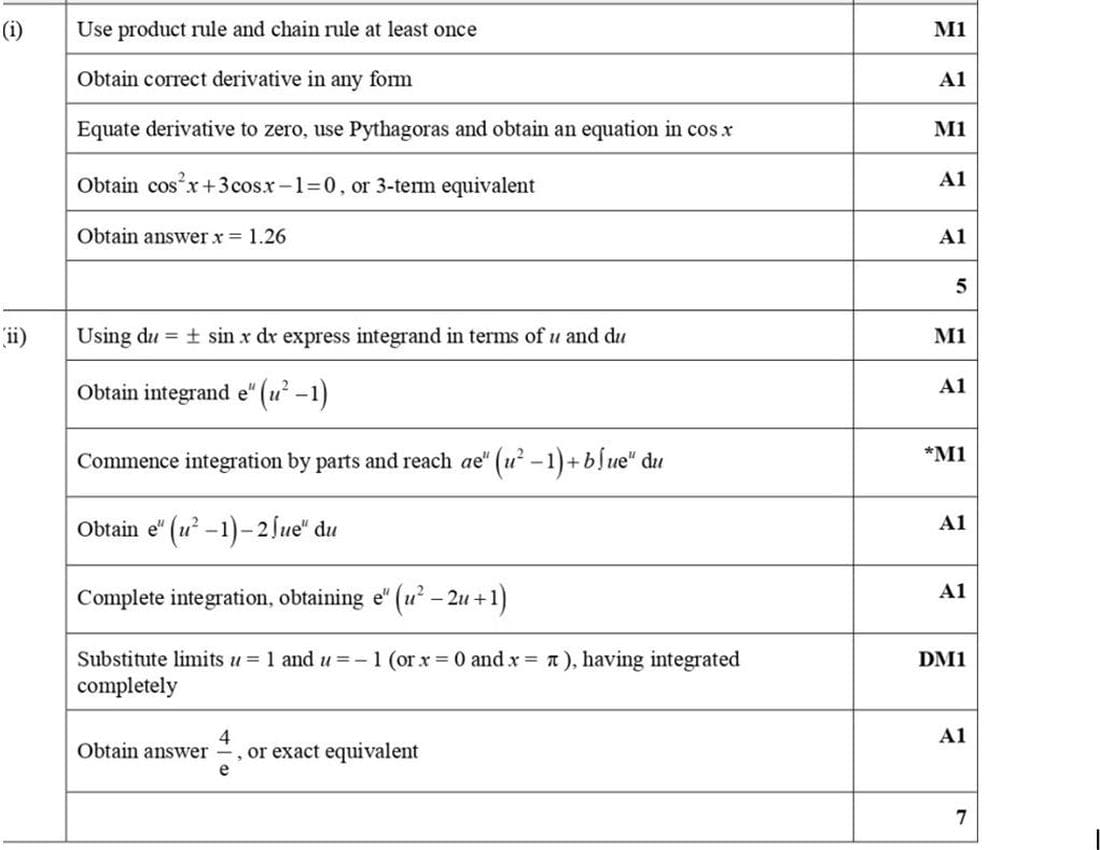
For \(-\sin x + 3\cos x = 0\), solve for \(\cos^2 x + 3\cos x - 1 = 0\).
Using the quadratic formula, find \(\cos x\) and then \(x\):
\(x = 1.26\) (to 2 decimal places).
(ii) Use the substitution \(u = \cos x\), then \(du = -\sin x \, dx\).
The integral becomes \(\int e^u (u^2 - 1) \, du\).
Integrate by parts:
\(\int e^u (u^2 - 1) \, du = e^u (u^2 - 1) - 2\int ue^u \, du\).
Complete the integration to obtain:
\(e^u (u^2 - 2u + 1)\).
Substitute back the limits \(u = 1\) and \(u = -1\) (or \(x = 0\) and \(x = \pi\)):
The area \(R\) is \(\frac{4}{e}\).