Browsing as Guest. Progress, bookmarks and attempts are disabled.
Log in to track your work.
Feb/Mar 2017 p32 q10
1772
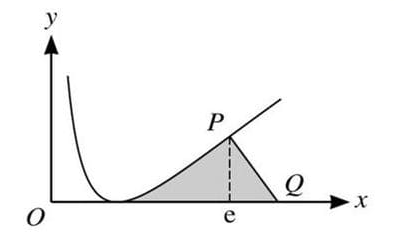
The diagram shows the curve \(y = (\ln x)^2\). The x-coordinate of the point \(P\) is equal to \(e\), and the normal to the curve at \(P\) meets the x-axis at \(Q\).
(i) Find the x-coordinate of \(Q\).
(ii) Show that \(\int \ln x \, dx = x \ln x - x + c\), where \(c\) is a constant.
(iii) Using integration by parts, or otherwise, find the exact value of the area of the shaded region between the curve, the x-axis and the normal \(PQ\).
Solution
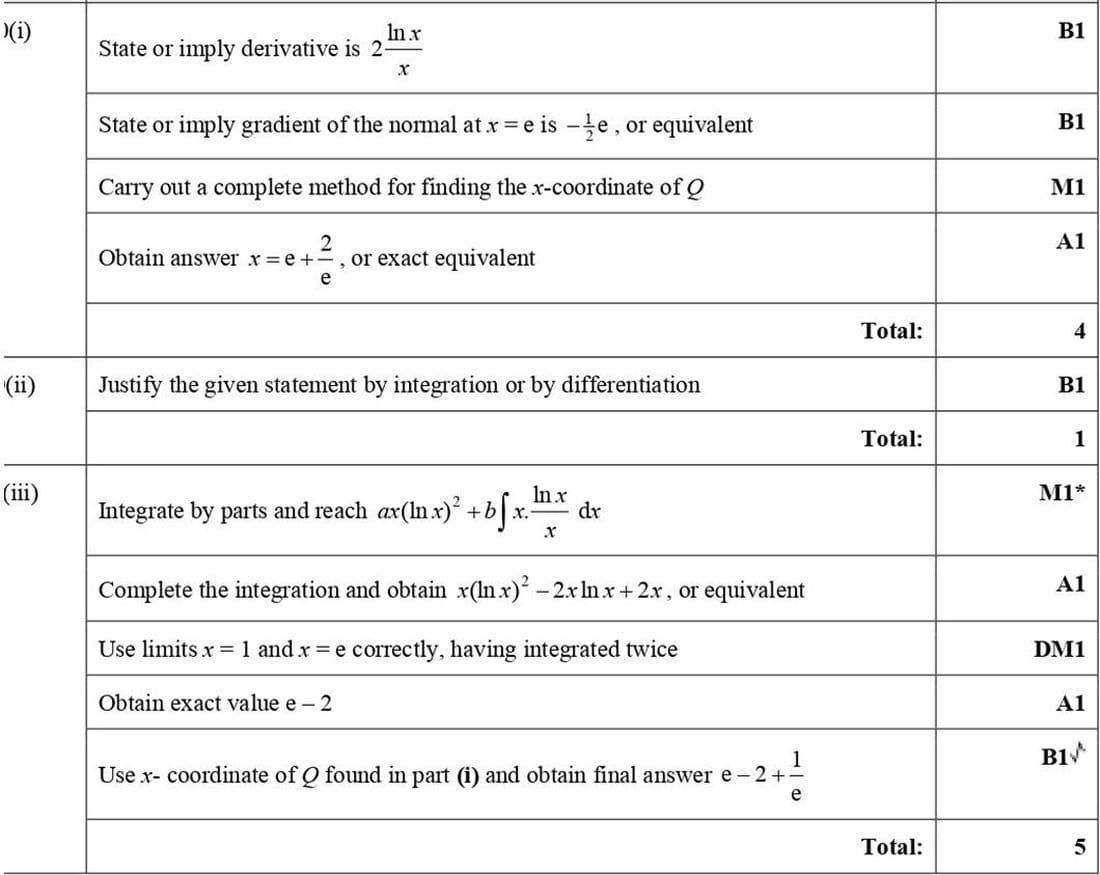
(i) The derivative of \(y = (\ln x)^2\) is \(\frac{2 \ln x}{x}\). At \(x = e\), the gradient of the tangent is \(\frac{2 \ln e}{e} = \frac{2}{e}\). The gradient of the normal is the negative reciprocal, \(-\frac{e}{2}\). The equation of the normal at \(P(e, 1)\) is \(y - 1 = -\frac{e}{2}(x - e)\). Setting \(y = 0\) to find \(Q\), we solve \(0 - 1 = -\frac{e}{2}(x - e)\), giving \(x = e + \frac{2}{e}\).
(ii) To show \(\int \ln x \, dx = x \ln x - x + c\), use integration by parts: let \(u = \ln x\) and \(dv = dx\), then \(du = \frac{1}{x} dx\) and \(v = x\). Thus, \(\int \ln x \, dx = x \ln x - \int x \cdot \frac{1}{x} \, dx = x \ln x - x + c\).
(iii) The area under the curve from \(x = 1\) to \(x = e\) is \(\int_1^e (\ln x)^2 \, dx\). Using integration by parts, let \(u = (\ln x)^2\) and \(dv = dx\), then \(du = \frac{2 \ln x}{x} dx\) and \(v = x\). Thus, \(\int (\ln x)^2 \, dx = x(\ln x)^2 - \int x \cdot \frac{2 \ln x}{x} \, dx = x(\ln x)^2 - 2 \int \ln x \, dx\). From part (ii), \(\int \ln x \, dx = x \ln x - x\), so \(\int (\ln x)^2 \, dx = x(\ln x)^2 - 2(x \ln x - x) = x(\ln x)^2 - 2x \ln x + 2x\). Evaluating from \(x = 1\) to \(x = e\), we find the area is \(e - 2\). The area of the triangle formed by the normal is \(\frac{1}{2} \times \frac{2}{e} \times 1 = \frac{1}{e}\). The total area is \(e - 2 + \frac{1}{e}\).