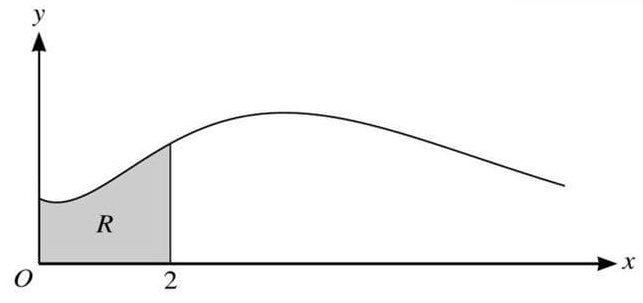
(i) To find the stationary points, we need to differentiate \(y = (1 + x^2) e^{-\frac{1}{2}x}\) and set the derivative to zero. Using the product rule, let \(u = 1 + x^2\) and \(v = e^{-\frac{1}{2}x}\). Then \(\frac{du}{dx} = 2x\) and \(\frac{dv}{dx} = -\frac{1}{2} e^{-\frac{1}{2}x}\).
The derivative is \(\frac{dy}{dx} = u \frac{dv}{dx} + v \frac{du}{dx} = (1 + x^2)(-\frac{1}{2} e^{-\frac{1}{2}x}) + e^{-\frac{1}{2}x}(2x)\).
Simplifying, \(\frac{dy}{dx} = e^{-\frac{1}{2}x}(-\frac{1}{2} - \frac{1}{2}x^2 + 2x)\).
Setting \(\frac{dy}{dx} = 0\), we solve \(-\frac{1}{2} - \frac{1}{2}x^2 + 2x = 0\).
Multiplying through by \(-2\), we get \(x^2 - 4x - 1 = 0\).
Using the quadratic formula, \(x = \frac{4 \pm \sqrt{16 + 4}}{2} = 2 \pm \sqrt{3}\).
(ii) To find the area of \(R\), we integrate \(y = (1 + x^2) e^{-\frac{1}{2}x}\) from \(x = 0\) to \(x = 2\).
Using integration by parts, let \(u = 1 + x^2\) and \(dv = e^{-\frac{1}{2}x} dx\). Then \(du = 2x dx\) and \(v = -2e^{-\frac{1}{2}x}\).
The integral becomes \(\int (1 + x^2) e^{-\frac{1}{2}x} dx = -2(1 + x^2) e^{-\frac{1}{2}x} + \int 4x e^{-\frac{1}{2}x} dx\).
Integrating by parts again for \(\int 4x e^{-\frac{1}{2}x} dx\), we find \(-8xe^{-\frac{1}{2}x} - 2x^2 e^{-\frac{1}{2}x}\).
Evaluating from \(x = 0\) to \(x = 2\), we find the area is \(18 - \frac{42}{e}\).