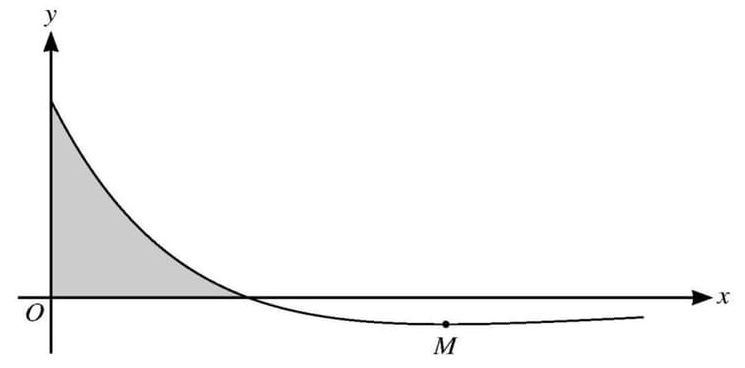
(a) To find the coordinates of \(M\), we need to find the minimum point of the curve \(y = (3-x)e^{-\frac{1}{3}x}\).
First, find the derivative \(\frac{dy}{dx}\) using the product rule:
\(\frac{dy}{dx} = -e^{-\frac{1}{3}x} - \frac{1}{3}(3-x)e^{-\frac{1}{3}x}\).
Set \(\frac{dy}{dx} = 0\) to find critical points:
\(-e^{-\frac{1}{3}x} - \frac{1}{3}(3-x)e^{-\frac{1}{3}x} = 0\).
Simplify and solve for \(x\):
\(x = 6\).
Substitute \(x = 6\) back into the original equation to find \(y\):
\(y = (3-6)e^{-\frac{1}{3} \times 6} = -3e^{-2}\).
Thus, the coordinates of \(M\) are \((6, -3e^{-2})\).
(b) To find the area of the shaded region, integrate the function from \(x = 0\) to \(x = 3\):
\(\int_{0}^{3} (3-x)e^{-\frac{1}{3}x} \, dx\).
Using integration by parts, we find:
\(-3e^{-\frac{1}{3}x}(3-x) + 9e^{-\frac{1}{3}x}\).
Evaluate from \(x = 0\) to \(x = 3\):
\(\left[-3e^{-1}(3-3) + 9e^{-1}\right] - \left[-3e^{0}(3-0) + 9e^{0}\right] = \frac{9}{e}\).
Thus, the area of the shaded region is \(\frac{9}{e}\).