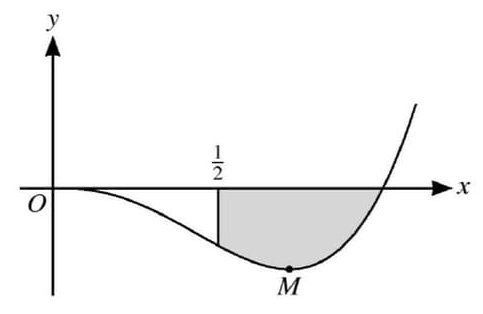
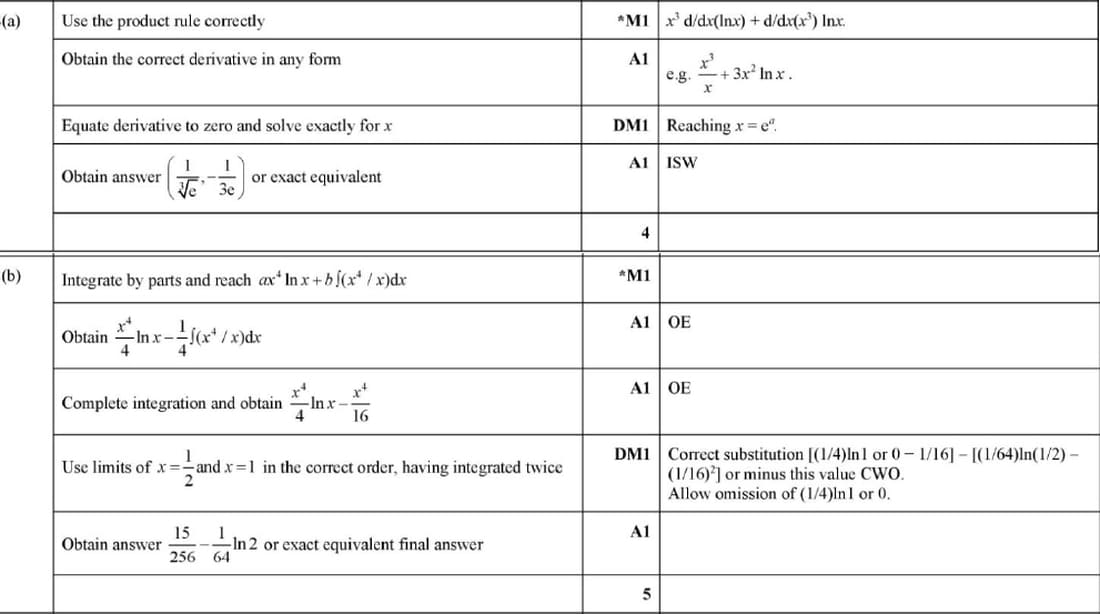
(a) To find the minimum point \(M\), we first find the derivative of \(y = x^3 \ln x\) using the product rule:
\(\frac{d}{dx}(x^3 \ln x) = x^3 \cdot \frac{d}{dx}(\ln x) + \ln x \cdot \frac{d}{dx}(x^3)\).
This simplifies to \(\frac{x^3}{x} + 3x^2 \ln x = x^2 + 3x^2 \ln x\).
Setting the derivative to zero gives:
\(x^2(1 + 3 \ln x) = 0\).
Since \(x > 0\), we solve \(1 + 3 \ln x = 0\) to find \(x = e^{-\frac{1}{3}} = \frac{1}{\sqrt{e}}\).
Substituting back into the original equation, \(y = \left( \frac{1}{\sqrt{e}} \right)^3 \ln \left( \frac{1}{\sqrt{e}} \right) = -\frac{1}{3e}\).
Thus, the coordinates of \(M\) are \(\left( \frac{1}{\sqrt{e}}, -\frac{1}{3e} \right)\).
(b) To find the area of the shaded region, we integrate \(y = x^3 \ln x\) from \(x = \frac{1}{2}\) to \(x = 1\).
Using integration by parts, let \(u = \ln x\) and \(dv = x^3 dx\), then \(du = \frac{1}{x} dx\) and \(v = \frac{x^4}{4}\).
The integral becomes:
\(\int x^3 \ln x \, dx = \frac{x^4}{4} \ln x - \int \frac{x^4}{4} \cdot \frac{1}{x} \, dx\).
This simplifies to:
\(\frac{x^4}{4} \ln x - \frac{1}{4} \int x^3 \, dx = \frac{x^4}{4} \ln x - \frac{x^4}{16}\).
Evaluating from \(x = \frac{1}{2}\) to \(x = 1\):
\(\left[ \frac{1^4}{4} \ln 1 - \frac{1^4}{16} \right] - \left[ \frac{(\frac{1}{2})^4}{4} \ln \frac{1}{2} - \frac{(\frac{1}{2})^4}{16} \right]\).
This simplifies to:
\(0 - \frac{1}{16} - \left( \frac{1}{64} \ln \frac{1}{2} - \frac{1}{256} \right)\).
Further simplification gives:
\(\frac{15}{256} - \frac{1}{64} \ln 2\).