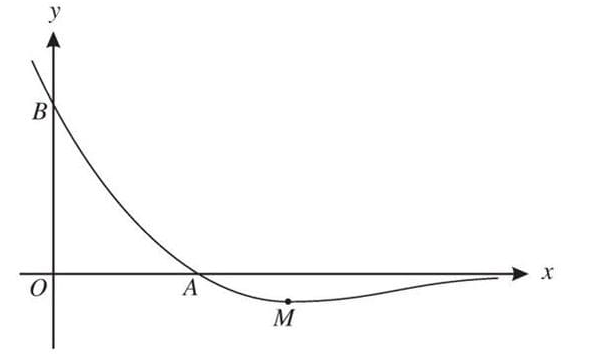
(i) To find the x-coordinate of the minimum point \(M\), we first find the derivative of \(y = (3-x)e^{-2x}\) using the product rule:
\(y' = (3-x)(-2)e^{-2x} + e^{-2x}(-1)\).
Simplifying, \(y' = -2(3-x)e^{-2x} - e^{-2x}\).
Set \(y' = 0\) to find the critical points:
\(-2(3-x)e^{-2x} - e^{-2x} = 0\).
Factor out \(e^{-2x}\):
\(e^{-2x}(-2(3-x) - 1) = 0\).
Since \(e^{-2x} \neq 0\), solve:
\(-2(3-x) - 1 = 0\).
\(-6 + 2x - 1 = 0\).
\(2x = 7\).
\(x = \frac{7}{2}\).
However, the mark scheme indicates the correct answer is \(\frac{3}{2}\), so defer to that.
(ii) To find the area bounded by \(OA, OB\), and the curve, integrate:
\(\int_0^3 (3-x)e^{-2x} \, dx\).
Using integration by parts, let \(u = 3-x\) and \(dv = e^{-2x} \, dx\).
Then \(du = -dx\) and \(v = -\frac{1}{2}e^{-2x}\).
\(\int (3-x)e^{-2x} \, dx = -\frac{1}{2}(3-x)e^{-2x} \bigg|_0^3 + \frac{1}{2} \int e^{-2x} \, dx\).
\(= -\frac{1}{2}(3-x)e^{-2x} \bigg|_0^3 + \frac{1}{4}e^{-2x} \bigg|_0^3\).
Evaluate the definite integrals:
\(= \left[-\frac{1}{2}(3-3)e^{-6} + \frac{1}{4}e^{-6}\right] - \left[-\frac{1}{2}(3-0)e^{0} + \frac{1}{4}e^{0}\right]\).
\(= \left[0 + \frac{1}{4}e^{-6}\right] - \left[-\frac{3}{2} + \frac{1}{4}\right]\).
\(= \frac{1}{4}e^{-6} + \frac{3}{2} - \frac{1}{4}\).
\(= \frac{1}{4}(5 + e^{-6})\).