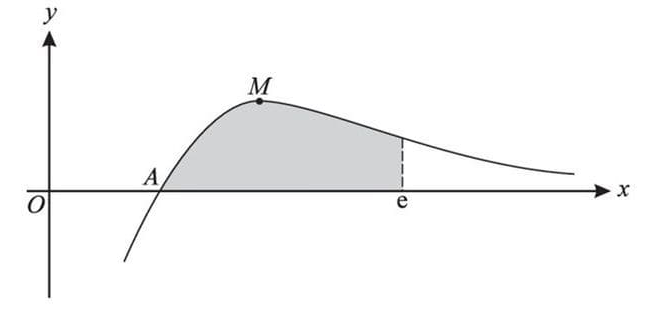
(i) To find the \(x\)-coordinate of \(A\), set \(y = 0\) in the equation \(y = \frac{\ln x}{x^2}\). This gives \(\ln x = 0\), so \(x = 1\).
(ii) To find the coordinates of \(M\), first find the derivative of \(y = \frac{\ln x}{x^2}\) using the quotient rule: \(y' = \frac{2 \ln x}{x^3} + \frac{1}{x^2}\). Set \(y' = 0\) to find the critical points: \(\frac{2 \ln x}{x^3} + \frac{1}{x^2} = 0\). Solving for \(\ln x\), we get \(x = e^{\frac{1}{2}}\). Substitute back to find \(y\): \(y = \frac{1}{2e}\). Thus, the coordinates of \(M\) are \(\left( e^{\frac{1}{2}}, \frac{1}{2e} \right)\).
(iii) To find the area, use integration by parts on \(\int_1^e \frac{\ln x}{x^2} \, dx\). Let \(u = \ln x\) and \(dv = \frac{1}{x^2} \, dx\), then \(du = \frac{1}{x} \, dx\) and \(v = -\frac{1}{x}\). The integration by parts formula gives:
\(\int \frac{\ln x}{x^2} \, dx = -\frac{\ln x}{x} + \int \frac{1}{x^2} \, dx\).
Evaluate the integral: \(-\frac{\ln x}{x} - \frac{1}{x}\) from 1 to \(e\). This results in:
\(\left[ -\frac{\ln x}{x} - \frac{1}{x} \right]_1^e = \left( -\frac{1}{e} - \frac{1}{e} \right) - \left( 0 - 1 \right) = 1 - \frac{2}{e}\).