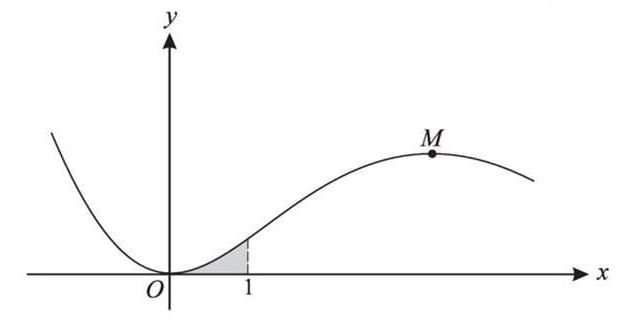
(i) To find the \(x\)-coordinate of \(M\), we need to find the derivative of \(y = x^2 e^{-\frac{1}{2}x}\) and set it to zero. Using the product rule, the derivative is:
\(\frac{d}{dx}(x^2 e^{-\frac{1}{2}x}) = 2x e^{-\frac{1}{2}x} - \frac{1}{2}x^2 e^{-\frac{1}{2}x}\).
Setting the derivative to zero:
\(2x e^{-\frac{1}{2}x} - \frac{1}{2}x^2 e^{-\frac{1}{2}x} = 0\).
Factor out \(e^{-\frac{1}{2}x}\):
\(e^{-\frac{1}{2}x} (2x - \frac{1}{2}x^2) = 0\).
Since \(e^{-\frac{1}{2}x} \neq 0\), solve \(2x - \frac{1}{2}x^2 = 0\):
\(x(2 - \frac{1}{2}x) = 0\).
\(x = 0\) or \(x = 4\).
Since \(x = 0\) is not a maximum, \(x = 4\) is the maximum point.
(ii) To find the area of the shaded region, integrate \(y = x^2 e^{-\frac{1}{2}x}\) from \(x = 0\) to \(x = 1\):
Use integration by parts: \(\int x^2 e^{-\frac{1}{2}x} \, dx\).
Let \(u = x^2\), \(dv = e^{-\frac{1}{2}x} \, dx\).
Then \(du = 2x \, dx\), \(v = -2e^{-\frac{1}{2}x}\).
\(\int x^2 e^{-\frac{1}{2}x} \, dx = -2x^2 e^{-\frac{1}{2}x} + 4 \int x e^{-\frac{1}{2}x} \, dx\).
Integrate \(\int x e^{-\frac{1}{2}x} \, dx\) by parts again.
Let \(u = x\), \(dv = e^{-\frac{1}{2}x} \, dx\).
Then \(du = dx\), \(v = -2e^{-\frac{1}{2}x}\).
\(\int x e^{-\frac{1}{2}x} \, dx = -2x e^{-\frac{1}{2}x} + 4 \int e^{-\frac{1}{2}x} \, dx\).
\(\int e^{-\frac{1}{2}x} \, dx = -2e^{-\frac{1}{2}x}\).
Complete the integration:
\(-2(x^2 + 4x + 8)e^{-\frac{1}{2}x}\).
Evaluate from \(x = 0\) to \(x = 1\):
\([-2(1^2 + 4 \cdot 1 + 8)e^{-\frac{1}{2}}] - [-2(0^2 + 4 \cdot 0 + 8)e^{0}]\).
\(= -26e^{-\frac{1}{2}} + 16\).
Final area: \(16 - 26e^{-\frac{1}{2}}\).