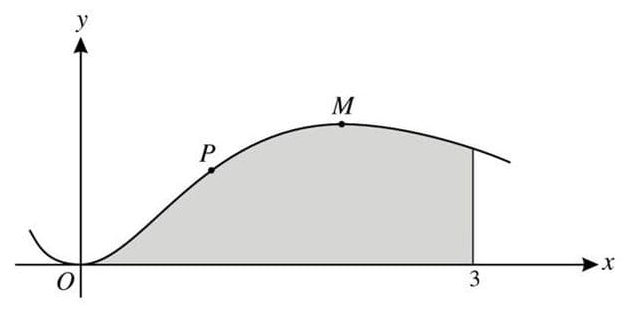
(i) To find the area under the curve \(y = x^2 e^{-x}\) from \(x = 0\) to \(x = 3\), we integrate:
\(\int_0^3 x^2 e^{-x} \, dx\)
Using integration by parts, let \(u = x^2\) and \(dv = e^{-x} \, dx\). Then \(du = 2x \, dx\) and \(v = -e^{-x}\).
\(\int x^2 e^{-x} \, dx = -x^2 e^{-x} + \int 2x e^{-x} \, dx\)
Apply integration by parts again to \(\int 2x e^{-x} \, dx\):
Let \(u = 2x\) and \(dv = e^{-x} \, dx\). Then \(du = 2 \, dx\) and \(v = -e^{-x}\).
\(\int 2x e^{-x} \, dx = -2x e^{-x} + \int 2 e^{-x} \, dx\)
\(= -2x e^{-x} - 2e^{-x}\)
Substitute back:
\(\int x^2 e^{-x} \, dx = -x^2 e^{-x} - 2x e^{-x} - 2e^{-x}\)
Evaluate from \(x = 0\) to \(x = 3\):
\(\left[ -x^2 e^{-x} - 2x e^{-x} - 2e^{-x} \right]_0^3\)
At \(x = 3\):
\(-9e^{-3} - 6e^{-3} - 2e^{-3} = -17e^{-3}\)
At \(x = 0\):
\(0 - 0 - 2 = -2\)
Thus, the area is:
\(-(-2) - (-17e^{-3}) = 2 - \frac{17}{e^3}\)
(ii) To find the maximum point, differentiate \(y = x^2 e^{-x}\):
\(\frac{dy}{dx} = 2x e^{-x} - x^2 e^{-x} = e^{-x}(2x - x^2)\)
Set \(\frac{dy}{dx} = 0\):
\(e^{-x}(2x - x^2) = 0\)
\(2x - x^2 = 0\)
\(x(2 - x) = 0\)
\(x = 0\) or \(x = 2\). Since \(x = 0\) is not a maximum, \(x = 2\) is the maximum point.
(iii) The tangent at \(P\) passes through the origin. The equation of the tangent at \(x = a\) is:
\(y - a^2 e^{-a} = (2a - a^2)e^{-a}(x - a)\)
Substitute \((0,0)\):
\(0 - a^2 e^{-a} = (2a - a^2)e^{-a}(0 - a)\)
\(a^2 = a^2(2 - a)\)
\(2 - a = 1\)
\(a = 1\). Thus, \(x = 1\).